
Zero-Cost AI Printify TikTok Shop Profits

Making money online sounds easy until you actually try it. That’s when reality hits—the hidden costs lurking around every corner.
Ads drain budgets fast. Inventory sits unsold. Software subscriptions multiply like rabbits. Course fees promise shortcuts but deliver more confusion.
Even the supposedly ‘free’ methods have a price tag. They just charge you in time instead of money—endless outreach that goes nowhere, content creation that takes months before the first dollar rolls in, free tools that always seem to need an upgrade right when you’re gaining traction.
The learning curve stings too. Dropshipping forces you into constant supplier negotiations and quality control battles. Affiliate marketing demands a content machine that never stops. Digital products? You’re building funnels, crafting email sequences, and targeting audiences before you see a penny.
Most people dive in chasing quick money, only to find themselves drowning—spending more than they earn, overwhelmed by complexity, or quitting before results ever materialize.
But print-on-demand breaks that pattern.
No products to stock. No warehouse nightmares. No financial risk. You pay for products only after customers order them, and fulfillment runs on autopilot. Yet even here, sellers hit walls.
The biggest wall? Design. Not everyone can make designs that sell, and hiring designers costs real money. Then comes marketing—how do you get eyeballs on your products without burning cash on ads? Social media might work, but building an audience from zero takes patience most people don’t have.
AI demolishes those walls.
Instead of hiring designers or wrestling with clunky software, AI tools generate print-ready designs in seconds. Instead of brainstorming for hours, AI identifies what’s trending and suggests winning products instantly.
Marketing stops being a puzzle requiring a strategy manual and months of experimentation. AI-powered tools like TikTok Shop’s automation handle content creation, video production, even customer conversations—delivering free traffic while you focus on other things. Combine AI with print-on-demand and the need for money, skill, or marketing expertise evaporates.
With the right approach, you can set up a store, generate designs, and start selling without spending a dollar. The crucial factor is working smarter—letting AI handle the heavy lifting while you launch and scale.
Print-on-demand already made it possible for beginners to start without upfront costs. AI makes it faster, easier, and more profitable than it’s ever been.
The No-Cost Business Model
Printify lets you run an online store without touching inventory, managing suppliers, or paying for products upfront. Traditional eCommerce locks you into bulk purchasing, warehouse fees, and third-party logistics—all carrying financial risk.
Printify wipes that slate clean. Create a design, upload it to a product, list it for sale. When someone buys, Printify prints and ships directly to them automatically.
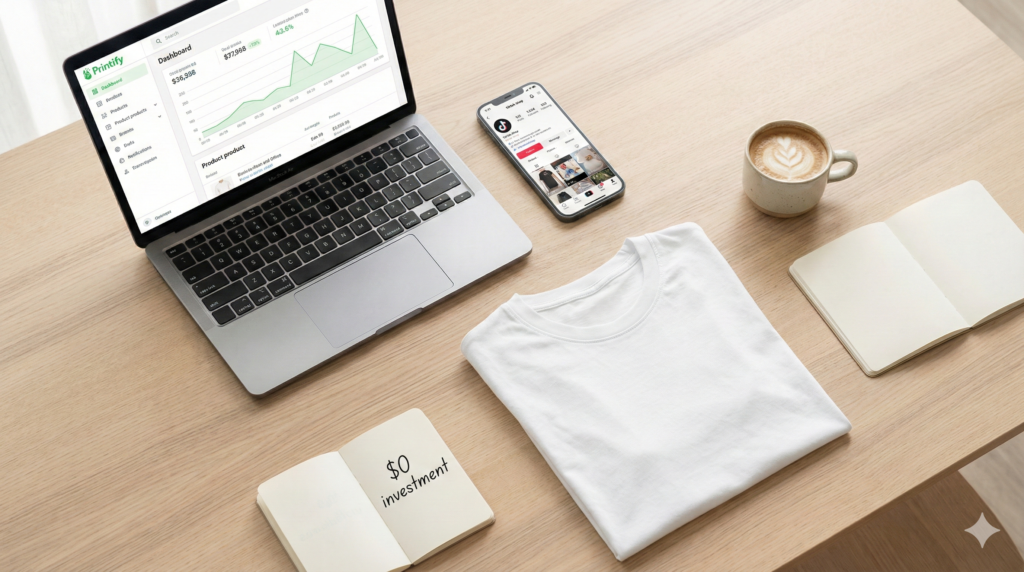
You never handle the product. Never guess at demand. Never worry about unsold inventory gathering dust. The entire operation runs without investment—one of the few online models where zero capital actually means zero capital.
It integrates with major platforms too, giving you multiple sales channels without juggling different systems. Connect Printify to TikTok Shop, Etsy, eBay, Shopify, Amazon—list products across all of them simultaneously.
Instead of depending on one traffic source, you tap into several at once. A shirt selling on TikTok? List it on Etsy or eBay instantly without extra work. Printify handles fulfillment regardless of where sales happen, so manual order tracking becomes someone else’s problem. This automation means scaling without increasing your workload.
TikTok Shop changes everything further by offering free, built-in traffic. Getting products in front of buyers without ad spend is eCommerce’s biggest challenge.
TikTok eliminates that challenge by pushing products into users’ feeds organically. List an item on TikTok Shop and it becomes eligible to appear before people already shopping on the platform.
Unlike paid ads where you’re constantly paying to stay visible, TikTok promotes products that gain engagement naturally. People interact with a video or click a product? TikTok shows it to more users. Free exposure without needing an existing following.
Better still, TikTok Shop integrates directly with Printify—no manual order processing or listing updates. Customers buy, orders go straight to Printify, printing and shipping happen automatically.
No tracking stock levels, packaging items yourself, or managing shipping inquiries. Everything runs behind the scenes while you focus on uploading designs and letting the platform work.
Because TikTok Shop prioritizes in-app purchases, customers never leave the app to check out. Conversions happen faster and easier. What makes this truly different is AI.
Normally, launching print-on-demand requires skills—graphic design, product research, social media marketing. AI removes those requirements. Instead of hiring designers or spending hours learning Photoshop, use AI to generate professional designs in seconds.
Instead of guessing which niches will sell, AI analyzes trends and suggests winning products instantly. Instead of struggling with marketing content, AI generates videos, captions, entire promotional campaigns.
This eliminates the expertise barrier, making it possible for anyone to launch without prior experience. AI-generated designs mean no reliance on basic text graphics or generic templates.
AI art tools create unique, high-quality images that look professional even if you have zero artistic ability. Want simple typography or complex illustrations? AI tools generate them from your descriptions.
You can also remix existing designs, adjust colors, create variations for different audiences—testing multiple styles quickly without extra effort. AI also transforms product marketing.
Traditionally, eCommerce sellers created content manually—filming product videos, writing descriptions, engaging potential buyers. AI automates everything. TikTok’s Symphony Creative Studio, available for business accounts, generates product videos for you. No content creation required.
AI tools write engaging descriptions, generate viral-style captions, provide automated customer responses. The entire marketing process runs on autopilot, delivering exposure and sales without active account management.
This automation level prevents overwhelm. Most people fail online because they hit too many roadblocks—technical difficulties, skill gaps, sheer workload.
AI removes those obstacles, letting you focus only on uploading designs and watching sales accumulate. Because AI tools work in the background, you scale much faster than handling everything manually. Instead of spending hours on a single product—designing, listing, promoting—you launch dozens at once while AI handles details.
The combination of Printify, TikTok Shop, and AI creates a fully automated system requiring no upfront investment, no special skills, minimal ongoing effort. You don’t need money, design knowledge, or marketing strategies.
AI handles creative work. TikTok Shop delivers free traffic. Printify manages fulfillment. Instead of months building audiences or testing marketing strategies, you start making sales almost immediately. This is one of the few truly passive online business models delivering results without financial risk or years of trial and error.
With Printify handling production, TikTok Shop providing free exposure, AI automating hard parts—making money online doesn’t have to be complicated. No worrying about inventory, product sourcing, or complex eCommerce strategies.

How AI Eliminates Every Obstacle
Traditional print-on-demand stumbles over three hurdles: creating sellable designs, finding trending products, and marketing effectively. AI doesn’t just clear these hurdles—it makes them disappear entirely.
AI-Generated Designs: Professional Quality in Seconds
Design used to be print-on-demand’s gatekeeper. You either learned graphic design, hired someone, or settled for basic text-based products. Each option cost time or money.
AI changed that equation completely. Tools like DALL-E, Midjourney, and Stable Diffusion generate complex, professional designs from simple text descriptions. No artistic skill required.
Want a vintage-style illustration of a golden retriever wearing sunglasses? Type the description. Need a minimalist line drawing of mountains at sunset? Describe it. AI generates multiple variations instantly, letting you choose the best option or combine elements from different versions.
The quality rivals what professional designers create, but the speed and cost difference is massive. A designer might charge $50-$200 per design and take days to deliver. AI generates comparable designs in seconds for pennies—or free if you use tools like Bing Image Creator or basic Stable Diffusion interfaces.
This speed advantage changes everything. Traditional sellers might launch 5-10 designs per week. With AI, you can test 50-100 variations in the same timeframe. More products means more chances to discover what sells, and AI makes that volume manageable.
AI also handles niche-specific design without requiring niche expertise. Want designs for fishing enthusiasts? Dog lovers? Nurses? Teachers? AI generates relevant imagery without needing to understand those communities yourself. Just describe what you need and AI produces designs that resonate with those audiences.
The design process becomes iterative too. See something that almost works? Adjust the prompt, regenerate, refine. This trial-and-error approach that would be prohibitively expensive with human designers becomes essentially free with AI.
AI Product Research: Finding Winners Before the Competition
Product research traditionally meant hours scanning bestseller lists, analyzing competitors, tracking trends manually. You’d spend entire days trying to identify what might sell, often guessing wrong.
AI compresses that research into minutes. ChatGPT can analyze current trends, suggest profitable niches, identify seasonal opportunities. Ask ‘What are trending print-on-demand niches for autumn 2024?’ and get specific, actionable suggestions based on current market data.
Tools like Google Trends integrate with AI to provide real-time market intelligence. AI can analyze search volume patterns, identify emerging trends before they peak, suggest product ideas based on increasing interest rather than existing saturation.
This predictive capability gives you a competitive edge. Instead of copying what’s already popular (and probably saturated), you’re identifying what’s about to become popular. Getting in early means less competition and higher profit margins.
AI also analyzes product performance across platforms. By processing data from TikTok Shop, Etsy, Amazon simultaneously, AI identifies what’s working where. Maybe funny dog shirts sell well on TikTok but minimalist designs dominate Etsy. AI spots those platform-specific patterns that would take months to notice manually.
The research doesn’t stop at product selection. AI suggests pricing strategies, identifies optimal product combinations, recommends which products to bundle together. It’s like having a market research team working 24/7 without the payroll costs.
AI Marketing Automation: Content That Creates Itself
Marketing is where most print-on-demand sellers hit a wall. Creating consistent, engaging content across platforms drains time and energy. You need product photos, video scripts, captions, descriptions, responses to comments—it never ends.
AI turns that constant demand into background noise. TikTok’s Symphony Creative Studio generates product videos automatically from your listings. Feed it product images and descriptions, get back polished videos ready to post. No filming, editing, or video production knowledge required.
ChatGPT writes compelling product descriptions optimized for conversion. Instead of agonizing over how to describe a hoodie for thirty minutes, prompt AI: ‘Write an engaging, benefit-focused product description for a funny dog lover hoodie.’ Get back professional copy in seconds.
Social media captions? AI generates them with appropriate hashtags, calls-to-action, and platform-specific formatting. Instagram needs different copy than TikTok needs different copy than Pinterest. AI adjusts tone and style automatically for each platform.
Customer service automation takes this further. AI chatbots handle common questions about sizing, shipping, materials—answering instantly while you sleep. This responsiveness improves customer satisfaction without requiring constant availability.
Email marketing becomes automated too. AI generates welcome sequences, cart abandonment emails, promotional campaigns. The personalization that typically requires expensive marketing software happens through simple AI prompts.
Most impressively, AI creates content calendars. Tell it to generate two weeks of social media posts for your dog-themed print-on-demand store, get back 14 days of ready-to-post content including images, captions, optimal posting times. Content consistency that would normally require hours of planning happens in minutes.
The Compounding Effect: How AI Advantages Stack
The real power emerges when these AI capabilities work together. Fast design generation + accurate product research + automated marketing creates a multiplicative advantage.
Traditional sellers might launch one product per day, spending hours on design, research, and promotion. AI-powered sellers launch ten products daily, each optimized through research, professionally designed, and marketed across multiple platforms automatically.
That 10x advantage compounds over time. After one month, traditional sellers have 30 products listed. AI-powered sellers have 300. More products means more chances for viral hits, more data to analyze, more revenue streams.
The feedback loop accelerates too. AI analyzes which products perform best, generates similar designs, creates targeted marketing for those winners. Success breeds more success, faster than manual optimization ever could.
This isn’t just efficiency—it’s a fundamental business model transformation. AI doesn’t make print-on-demand slightly easier. It makes it radically different, removing barriers that kept most people from succeeding.
Setting Up Your Zero-Cost Store
Theory sounds great, but implementation determines success. Here’s the exact process for launching a profit-generating store without spending money.
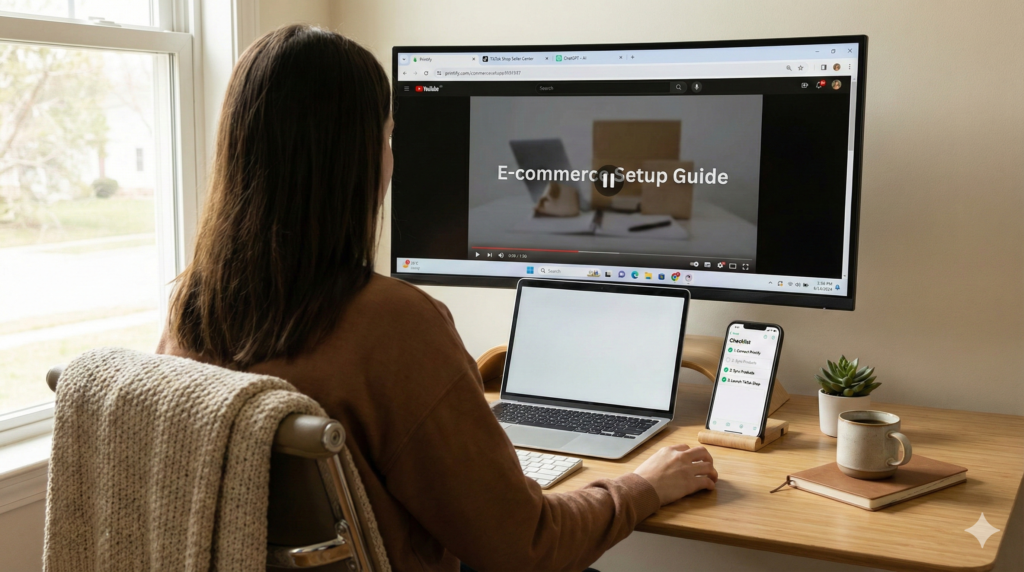
Step 1: Create Your Printify Account
Visit Printify.com and sign up. The free plan includes everything you need—no trial period, no credit card required.
Printify offers two premium tiers (Premium and Enterprise), but the free plan works perfectly for starting. Premium provides lower product costs and faster shipping once you’re scaling, but beginners should start free and upgrade only when profit justifies it.
After signing up, browse the product catalog. T-shirts, hoodies, mugs, phone cases, posters, tote bags—hundreds of products available for customization. Each product listing shows manufacturing cost, shipping time, available colors, size ranges.
Start with basics: t-shirts and hoodies. These products have proven demand, wide appeal, and good profit margins. Once you understand the process, expand into specialty items based on your niche.
Step 2: Generate Your First Designs with AI
This is where AI eliminates traditional barriers. You don’t need Photoshop, Illustrator, or design skills. You need clear descriptions and basic AI tools.
Start with free AI image generators:
• Bing Image Creator (powered by DALL-E, completely free with Microsoft account)
• Stable Diffusion via DreamStudio (free credits upon signup)
• Leonardo.AI (free tier with daily generation limits)
Open your chosen tool and describe what you want. Specificity matters. Instead of ‘dog picture,’ try: ‘Minimalist line drawing of a golden retriever sitting, black and white, simple clean lines, suitable for t-shirt printing.’
Generate multiple variations. AI isn’t perfect on the first try, but it produces options fast. Generate five versions, pick the best one or combine elements you like.
For text-based designs, use Canva’s free tier. While Canva isn’t AI-powered for text, it provides templates and fonts that work well for simple quote-based products. Combine Canva text with AI-generated graphics for unique hybrid designs.
Download your designs in PNG format with transparent backgrounds when possible. Printify handles most file types, but PNG with transparency gives you the most flexibility in product placement.
Step 3: Upload Designs and Create Products
Back in Printify, click ‘Create New Product.’ Select your product type (t-shirt to start). Choose a supplier—Printify lists several for each product type.
Supplier selection matters. Look for:
• High ratings (4.5+ stars)
• Fast production times (2-4 days ideally)
• Reasonable manufacturing costs (higher costs eat profit margins)
• Good shipping options (multiple carriers, reasonable delivery windows)
Upload your design. Printify’s editor lets you position, resize, and preview how your design looks on different colors. Check the preview carefully—what looks good on white might disappear on light gray.
Select which colors you want to offer. More colors mean more options for customers but also more variants to manage. Start with 3-5 popular colors, expand if demand shows preference for variety.
Write your product title and description. This is where AI helps again. Prompt ChatGPT: ‘Write a compelling product title and description for a t-shirt featuring a minimalist golden retriever design aimed at dog lovers.’ Get back optimized copy instantly.
Set your retail price. Calculate profit margin: retail price minus (manufacturing cost + Printify fee + platform fee). For t-shirts, aim for at least $5-10 profit per sale. Check competitor pricing on TikTok Shop and Etsy to stay competitive while maintaining profit margins.
Publish to Printify’s catalog. Your product is now ready to connect to selling platforms.
Step 4: Connect TikTok Shop for Free Traffic
TikTok Shop delivers the free traffic that makes this model work. Setting it up requires a business TikTok account and seller registration.
If you don’t have a TikTok account yet, create one. Switch to a business account in settings (free, takes 30 seconds). Business accounts unlock TikTok Shop integration and Symphony Creative Studio.
Apply for TikTok Shop seller status. Requirements vary by country but generally include:
• Business email
• Basic business information
• Bank account for payments
You don’t need a registered business entity in most cases—sole proprietors qualify. Approval typically takes 1-3 business days.
Once approved, connect Printify to TikTok Shop through Printify’s integrations page. Authorize the connection, and your products sync automatically. Every product you publish in Printify becomes available in your TikTok Shop.
Orders placed through TikTok Shop flow directly to Printify without manual intervention. Customer buys on TikTok, Printify receives order, produces item, ships to customer, profit deposits to your account. You literally don’t touch anything.
Step 5: Create AI-Generated Product Videos
TikTok Shop products need videos for maximum visibility. This is where Symphony Creative Studio becomes invaluable.
Access Symphony through TikTok’s business suite. Select ‘Create Video,’ choose your product from your shop. Symphony generates video options automatically:
• Product showcase videos
• Lifestyle-integrated videos
• Animated product reveals
• Comparison videos
Choose the style that fits your product best, let Symphony render it. The output is a polished video with trending music, professional transitions, and product information—ready to post.
For additional control, use free tools like CapCut (owned by TikTok’s parent company, integrates seamlessly). Upload your product images, let CapCut’s AI features create transitions and effects.
Write video captions with ChatGPT. Prompt: ‘Write a short, engaging TikTok caption for a dog lover t-shirt. Include relevant hashtags and a call-to-action to buy.’ Get back optimized copy that follows TikTok’s viral formula.
Post videos consistently. TikTok’s algorithm rewards regular posting. Aim for one video per day at minimum. With AI handling creation, producing daily content takes minutes rather than hours.
Step 6: Expand to Additional Platforms
TikTok Shop provides initial momentum, but platform diversification protects against algorithm changes and maximizes reach.
Connect Printify to Etsy:
Etsy charges $0.20 per listing plus 6.5% transaction fee. Small costs, but they add up. List your best-performing TikTok products first rather than your entire catalog.
Etsy’s audience differs from TikTok’s—typically older, higher purchasing power, seeking unique or personalized items. Adjust your product descriptions and photos to match Etsy’s aesthetic expectations.
Connect Printify to eBay:
eBay offers free listings up to a monthly limit (varies by account). Zero-cost listing makes it worth testing. eBay shoppers often search for specific items, so SEO-optimized titles matter more than visual appeal.
Consider Shopify for long-term brand building:
Shopify isn’t free—plans start at $39/month. Wait until you’re consistently profitable before adding this expense. Once you justify it, Shopify provides complete control over branding, customer experience, and profit margins (no marketplace fees).
Amazon Merch on Demand as you scale:
Amazon’s print-on-demand program requires approval and has upload limits initially. Apply once you’ve validated designs on other platforms. Amazon’s massive traffic can transform winning designs into consistent income streams.
Each platform requires initial setup, but AI speeds the process dramatically. Use ChatGPT to generate platform-specific product descriptions, titles, and tags. One design becomes five platform listings in minutes rather than hours.

Maximizing Profits Through AI Optimization
Launching is step one. Optimization determines long-term success. AI doesn’t just help you start—it helps you grow smarter and faster.
Tracking What Actually Sells
Data drives decisions, but most sellers drown in metrics without knowing what matters. AI helps you focus on signals rather than noise.
TikTok Shop and marketplace dashboards provide conversion rates, view counts, add-to-cart ratios. Watch these numbers, but more importantly, watch patterns.
Which products get views but no purchases? Design appeals but price doesn’t. Test lower pricing or highlight value in descriptions.
Which products get added to cart but not purchased? Customers are interested but something creates hesitation. Check shipping costs, delivery times, product photos, return policies.
Which products convert immediately? Winners. Double down on these—create variations, expand color options, develop related designs in the same style.
Use ChatGPT to analyze this data. Export sales reports (most platforms support CSV), feed them to ChatGPT with a prompt: ‘Analyze this sales data and identify patterns in my top-performing products versus underperformers.’ AI spots trends you might miss manually.
AI can also identify external factors affecting sales—seasonal trends, holiday peaks, viral moments. ‘Why did sales spike on these dates?’ Upload your data, let AI connect dots between sales patterns and cultural events or trending topics.
Creating Winning Variations Fast
When you find a winner, speed matters. Competitors notice successful products quickly. Your advantage is velocity—getting variations to market before saturation hits.
AI excels at variation generation. A selling dog illustration? Generate similar but distinct versions instantly. Prompt: ‘Create a minimalist black-and-white line drawing of a golden retriever wearing sunglasses, similar in style to a vintage tattoo design.’
By tweaking designs rather than starting from scratch, you rapidly expand product catalogs while maintaining momentum. As soon as a product gains traction, capitalize by launching related designs likely to perform similarly.
AI-Generated Promo Content: Scripts, Captions, and Pins
Marketing creates the biggest obstacle for print-on-demand sellers. Creating consistent promotional content drains time, and many struggle writing captions, video scripts, or ad copy that converts. AI handles everything instantly, generating unlimited marketing materials with minimal effort.
For TikTok videos, ChatGPT creates compelling hooks and full scripts making product videos more engaging. Simple prompt: ‘Write a 30-second TikTok script promoting a funny dog lover hoodie. Tone should be playful and engaging.’
ChatGPT might generate:
[Opening Scene: Person holding up hoodie]
‘Dog lovers, this one’s for you! Ever feel like your entire life revolves around your dog? Same. That’s why I had to get this hoodie!’
[Cut to person wearing hoodie, walking their dog]
‘Soft? Check. Cozy? Check. Perfect excuse to talk about my dog all day? Also check.’
[Close-up of the hoodie’s design]
‘If you get it, you get it. And if you don’t? Well, you probably don’t have a dog.’
[Final Call to Action]
‘Link in bio—grab yours before it’s gone!’
This script provides ready-made video format following TikTok’s viral style, increasing engagement likelihood.
For Instagram captions, ChatGPT generates attention-grabbing copy encouraging likes and shares. Prompt: ‘Write an Instagram caption for a funny cat lover T-shirt. Make it witty and include a call-to-action.’
Might generate:
‘Fact: 99% of cat owners have had their keyboard hijacked at least once. 🐱💻 If you know the struggle, this tee is for you. Grab yours now before your cat sits on your phone and orders 12 more. 😹 #CatMomLife #FunnyCatTee’
For Pinterest, where text overlays on images matter, AI generates optimized pin descriptions:
‘Write a Pinterest pin description for a ‘Dog Mom’ hoodie, optimized for search visibility.’
Could return:
‘Looking for the perfect cozy hoodie for dog moms? This ‘Dog Mom Life’ sweatshirt is soft, comfy, and a must-have for any pet lover! Great for lounging, walking the dog, or layering up in style. Tap to shop now! #DogMomStyle #PetLoverGift #ComfyHoodie’
Using AI-generated scripts, captions, and pin descriptions lets you create consistent marketing content across multiple platforms in minutes, saving time while keeping your store visible and engaging.
Partnering with Influencers for Free Traffic
Paid ads devour profits quickly. Influencer marketing provides traffic without upfront costs. Many small TikTok and Instagram creators promote products for commissions, making this ideal for scaling print-on-demand stores without advertising budgets. AI streamlines the process by identifying potential influencers, crafting outreach messages, managing communication efficiently.
Find Small TikTok Creators Willing to Promote for Commissions
The best influencers to work with are micro-influencers (5,000-50,000 followers) with engaged audiences within specific niches. Selling funny pet-themed apparel? Target influencers regularly posting pet content. This ensures products reach audiences already interested in your niche.
To find influencers:
• Search relevant hashtags like #DogMomLife, #FunnyPetVideos, or #PetLover on TikTok and Instagram.
• Check who engages with similar products or brands.
• Use AI tools like Heepsy or Modash to analyze influencer engagement rates and audience demographics.
Once you have potential collaborators, AI generates personalized outreach messages increasing response rates.
AI-Generated Outreach Messages = Instant Collabs
Instead of generic messages, ChatGPT crafts personalized outreach scripts feeling natural and engaging. Strong prompt:
‘Write a casual and friendly outreach email to a TikTok influencer who posts funny dog videos. Invite them to partner with my store, [Your Brand Name], by promoting a funny dog lover hoodie in exchange for a commission on sales.’
ChatGPT might generate:
Subject: Let’s Make Dog Lovers Laugh (and Earn Together!) 🐶
‘Hey [Influencer’s Name],
I came across your TikTok videos, and I’m obsessed! Your dog content is hilarious, and I think your audience would love our funny dog lover hoodies.
We’re looking for pet-loving creators to collaborate with. No upfront cost—just a fun way to earn! If you wear and share our hoodie in a video, you’ll get a commission for every sale made through your unique link. Plus, we’ll send you a free hoodie just for joining!
Let me know if you’re interested, and I’ll send over the details. Can’t wait to team up!
Best,
[Your Name]
[Your Store Name]’
AI also tracks outreach progress, schedules follow-ups, generates responses keeping conversations moving smoothly.
Scaling Your Print-on-Demand Business with AI
Scaling’s key is automation. Using AI to track winning designs, generate marketing content, manage influencer collaborations eliminates bottlenecks typically slowing growth.
Instead of hours creating new products or figuring out promotion, AI lets you scale efficiently with minimal effort. Whether duplicating best-sellers, generating endless social media content, reaching out to influencers for free exposure—AI makes print-on-demand a hands-free business model continuing to grow without requiring more of your time.
There’s no risk starting print-on-demand, but profit potential is massive. You don’t need inventory, upfront investment, or design skills. AI removes the learning curve by handling product creation, marketing, even influencer outreach, turning what used to be complicated into a hands-free income stream.
TikTok Shop gives you free traffic and instant exposure, while Etsy, Amazon, and Shopify provide long-term stability and passive sales. Once you have a winning design, AI makes it effortless to replicate, scale, and expand across multiple platforms.
There’s no waiting, no financial risk, no barrier to entry. The only thing standing between you and a profitable print-on-demand business is taking action. With AI doing the heavy lifting, all you need to do is start.
Products / Tools / Resources
Getting started with AI-powered print-on-demand requires the right tools. Here’s what actually works, tested through real implementation:
Print-on-Demand Platform
Printify remains the go-to choice for zero-cost fulfillment. The free tier includes unlimited product uploads, integration with major marketplaces, and access to hundreds of suppliers worldwide. Premium plans ($29/month) reduce production costs once you’re selling consistently, but beginners should start free and upgrade when profit justifies it.
AI Design Tools
Bing Image Creator (powered by DALL-E) offers completely free image generation with a Microsoft account. Quality matches paid alternatives for most print-on-demand applications. Leonardo.AI provides a generous free tier with daily generation limits—excellent for testing multiple design concepts rapidly.
For more control, Midjourney ($10/month) generates consistently high-quality designs with precise prompt responses. Worth the investment once you’re validating concepts regularly. Stable Diffusion through DreamStudio gives free credits upon signup, then charges minimal amounts per generation—cost-effective for volume production.
ChatGPT (free tier) handles most marketing content needs—product descriptions, social captions, video scripts. The paid version ($20/month) processes prompts faster and accesses newer models, beneficial when generating content at scale.
TikTok’s Symphony Creative Studio comes free with business accounts. It automates video creation specifically for product promotion, saving hours of manual editing. CapCut (also free) provides additional editing control when you need custom video modifications.
Marketplace Integrations
TikTok Shop requires only a business TikTok account and seller approval—no ongoing fees. Etsy charges $0.20 per listing plus 6.5% transaction fees. Start by listing proven winners only to minimize initial costs. eBay offers free listings up to monthly limits, making it risk-free for testing additional traffic sources.
Influencer Outreach
Heepsy and Modash help identify micro-influencers with engaged audiences. Both offer free trials for initial research before requiring paid subscriptions. Most outreach can happen through direct Instagram/TikTok messages without specialized tools—AI-generated scripts through ChatGPT work directly in these platforms.
Analytics and Optimization
Each marketplace provides built-in analytics showing sales data, traffic sources, conversion rates. Export these reports periodically and feed them to ChatGPT for pattern analysis. Google Sheets (free) helps track performance across platforms when you’re selling on multiple marketplaces simultaneously.
The beauty of this model is starting costs remain near zero. As profits grow, selectively upgrade tools providing the highest ROI. Begin with completely free options (Printify, Bing Image Creator, ChatGPT free tier, TikTok Shop), then invest incrementally in tools proving their value through increased sales.