The Nano Banana AI Dashboard Explained: The Hidden System That Turns Raw Data Into Instant Decisions
There’s a moment every data-driven team eventually hits—when information stops illuminating and starts suffocating. Metrics multiply, dashboards stack on dashboards, and suddenly the “big picture” looks more like static. Somewhere inside all that noise is the truth you’re trying to act on… but finding it feels like running underwater.
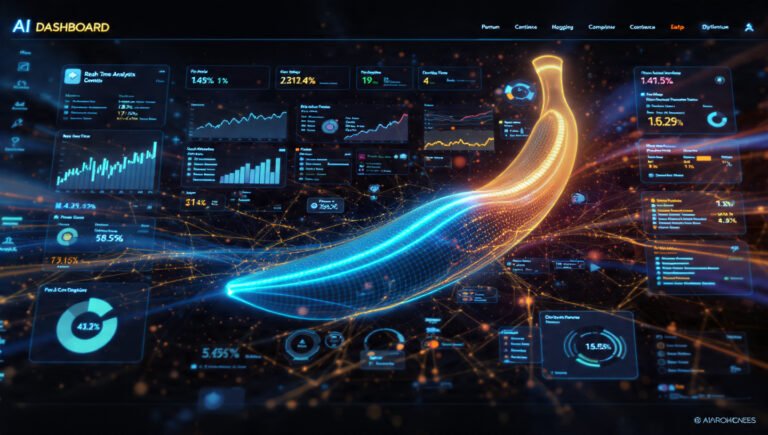
That’s the precise tension the Nano Banana AI Dashboard was built to dissolve. It’s quiet in its brilliance, understated in design, yet shockingly capable of taking scattered, high-velocity data and transforming it into decisions you can actually trust. But what is this system? How does it work beneath the surface? And why has it become a kind of secret weapon for teams trying to keep pace with AI-powered operations?
Let’s peel back that curtain—gently, carefully—and look at the architecture, psychology, and intelligence that make the Nano Banana AI Dashboard unlike any analytics tool you’ve ever used.
Where the Nano Banana AI Dashboard Fits Into the Modern AI Ecosystem
Before you understand how it works, you need to understand why it exists. The Nano Banana AI Dashboard isn’t just another reporting layer. It’s a decision engine—one designed for a world where data streams never sleep and human attention can’t possibly keep up.
Its architecture builds a bridge between four essential components:
the raw data itself
the pipelines that carry it
the models that interpret it
and the interface that brings everything, finally, into human view
The name may sound whimsical, but there’s a logic humming behind it:
Nano signals microscopic detail—the granular, frame-by-frame awareness that real-time systems demand.
Banana reflects a multi-layered structure, curved like a pipeline, wrapped like a shell.
AI Dashboard grounds it in purpose: a surface that reflects the intelligence happening beneath.
It’s playful, yes. But underneath? Steel.
How the Nano Banana AI Dashboard Thinks Behind the Glass
If you’ve ever wondered what it would feel like to sit inside a living, breathing intelligence system, this is where the dashboard begins to reveal itself. It doesn’t wait for you to go hunting through panels or slicing filters. It interprets the world as it comes.
Real-Time Data Ingestion That Feels Alive
Every second, the dashboard is drawing in:
event logs
transactional patterns
sensor signals
API streams
LLM transcripts
embedding vectors
It cleans, aligns, and organizes each piece before you even know it arrived. The data doesn’t pile up—it’s domesticated, structured, ready.
Where Data Turns Into Meaning: The Decision Layer
Here’s where the magic (and the math) meet.
Models are constantly scored and cross-checked. Their predictions are evaluated not just for accuracy, but for context. The dashboard generates explanations on its own—natural language insights pulled from embedding similarity, rule-based logic, and anomaly patterns.
You’re not staring at a number anymore.
You’re reading its story.
A Visualization Layer That Responds When You Do
Ask the dashboard a question and it doesn’t just show you an answer. It shapes the answer into something that fits the moment—expanding panels, highlighting patterns, surfacing anomalies you didn’t think to ask about.
Interacting with it feels less like querying a database and more like talking to a colleague who happens to have perfect recall and no ego.
The Nano Banana AI Dashboard in Everyday Work: What It Actually Does for People
It’s one thing to admire the architecture. It’s another to see how it changes the workday.
Business Intelligence With Pulse Instead of Lag
Teams use the dashboard to spot financial irregularities, predict demand swings, and catch operational shifts before they escalate. Instead of reports delivered hours later, the insights appear almost as the events happen.
Marketing and Customer Teams Finally See the “Why” Behind Behavior
Segmentation deepens. Churn becomes predictable. Customer journeys stop feeling like fog and start feeling like maps. Even the story behind performance—good or bad—comes with explanations baked in.
Engineers and Product Builders Get Clarity Without Digging
Telemetry. Error spikes. Feature-level performance. Everything is contextualized, not just displayed. The dashboard surfaces what deserves attention, not just what exists.
For AI Teams and LLM-Ops, It’s a New Nervous System
Model drift, hallucination patterns, token usage, reasoning traces—they appear in crisp detail. The dashboard doesn’t just show AI behavior; it interprets it the way an experienced operator would.
Why This Dashboard Feels Different From Anything Before It
Most dashboards answer questions you already knew to ask. Nano Banana answers the ones that blindside you.
Autonomous Interpretation Instead of Manual Detective Work
It notices shifts before you notice symptoms. It explains why a chart moved instead of waiting for you to figure it out.
Predictive Over Descriptive
Old dashboards describe the past. Nano Banana lives in the directional future, mapping out what’s coming next and the probabilities behind it.
NLP-First Design for Humans, Not Analysts
Ask it anything, casually or technically. The dashboard translates your question into the logic that retrieves the answer. No syntax. No queries. No hesitation.
It meets you where you are, not where your SQL certifications happen to be.
Who Should Actually Use the Nano Banana AI Dashboard
Some tools work best for specialists. This one spreads its value across entire organizations—but only if certain conditions exist.
Teams That Thrive With It
fast-moving analytics groups
AI/ML teams managing multiple models
growth, product, and marketing teams
operations teams dealing with volatility
anyone drowning in dashboards already
What You Need to Make It Work
A data source—any kind of source—is enough to begin.
From there, everything scales with your infrastructure: LLM logs, telemetry streams, vector databases, whatever you trust.
How You Know It’s a Fit
If you’ve ever wished your data could just tell you what matters, this is your sign.
How to Deploy, Refine, and Avoid Missteps With Nano Banana
Getting started isn’t complicated, but mastery comes from nuance.
A Quick Setup Path
Connect your raw or processed data streams.
Register your models, if applicable.
Customize alert sensitivity.
Pick your visualization styles.
Enable the interpretation engine.
Fine-Tuning for Performance
Use conversational queries often—they train your intuition and reveal hidden features. Review drift reports weekly. Compare prediction deltas against historical baselines. These patterns become second nature quickly.
Pitfalls to Avoid
Setting alert thresholds too low
Pushing unstructured data without at least a minimal schema
Overcrowding dashboards with redundant panels
The system works best when allowed to breathe.
A Human-Sized Explanation: Nano Banana AI Dashboard in One Breath
The Nano Banana AI Dashboard turns real-time data into immediate, understandable decisions. It watches your models, senses changes, predicts outcomes, explains itself in natural language, and gives you a living window into your company’s intelligence—without making you chase metrics or decode charts.
Questions People Quietly Ask Before They Try It
“What do people actually use this dashboard for?”
Mostly to replace scattered reporting tools with something that thinks. It centralizes monitoring, interpretation, prediction, and explanation in one place.
“I’m new to AI dashboards. Will I understand it?”
You will. The whole interface is built around natural-language interaction, so you’re guided rather than overwhelmed.
“Does it really help with LLM oversight?”
Yes. In fact, that’s where it shines—tracking drift, hallucination patterns, token flows, reasoning traces, and model behavior over time.
“Is this replacing BI tools?”
Not replacing—surpassing. Traditional dashboards describe the past. Nano Banana describes the future.
“Does it connect easily with my existing tools?”
If your tools produce data, logs, or embeddings, the dashboard can ingest them. APIs, databases, webhooks—everything plays nicely.
Other Resources To Learn Nano Banana AI
- The Hidden Engine Behind Nano Banana AI: What It Is, How It Works & Why Everyone’s Talking About It
- How to Use Nano Banana AI Like a Power User: Advanced Tricks, Hidden Settings, and High-Impact Prompt Tactics
PRODUCTS / TOOLS / RESOURCES
Tools that naturally pair with the Nano Banana AI Dashboard:
Real-Time Data Stream Platforms
Ideal for feeding continuous telemetry—Kafka, Pulsar, or any structured event pipeline.Model Monitoring & Experiment Tracking Utilities
Useful for teams running multiple AI models or LLM agents in production.Vector Databases & Embedding Stores
A perfect match for the dashboard’s similarity search and NLP interpretation layers.API Integrators & Workflow Automation Tools
Help connect your existing ecosystem to the dashboard with minimal friction.
Each of these supports the dashboard’s strengths: clarity, prediction, and speed—turning your data environment into something far more alive and far more generous than a collection of reports.
Get Your Free Nano Banana AI Training