
How to Turn Ideas Into Products Fast Using AI Prompts

You’ve got an idea. Maybe it’s half-formed, still stuck in the notes app on your phone, or scratched on the back of a receipt. You know it’s good—or at least, you think it might be. But between that spark and something you can actually sell? That’s where most ideas go to die.
Not because they weren’t worth it. Because the distance between concept and product feels impossible to cross without losing your mind somewhere around draft three.
This is different.
The Prompt-to-Product Conversation Scripts Pack isn’t another collection of “insert your topic here” templates that spit out generic garbage. It’s a relay system. One continuous thread that carries you from rough idea to finished product, sales page, and follow-up emails—without making you start over every time you switch gears.
Instead of treating AI like a one-off tool you consult in desperate moments, you’ll run a single conversation that builds on itself. Each prompt hands off to the next. Context compounds. Nothing gets lost in translation because you never broke the chain.

How to Use This Library
Start where you actually are. If you’re still validating whether your idea has legs, begin with the Idea Validation and Market Friction section. Already know what you’re building? Jump straight to Strategic Outline Architecture. The sections stack, but they’re not rigid. You can use them in order or grab what you need when you need it.
When you copy a prompt, replace the bracketed bits with your specifics. Don’t write “[niche]”—write “email marketing for service providers who hate writing.” Don’t say “[audience]”—say “freelancers with tiny lists who feel like imposters every time they hit send.” The sharper you get, the better this works.

Here’s the key: keep the same conversation thread going. Don’t start fresh every time. The relay only works if AI remembers what you’ve already built. Feed one output into the next. Let context accumulate. That’s how you avoid repeating yourself and keep everything locked in tight.
Adjust as you go. These prompts are starting points, not scripture. If something asks for ten ideas but you only want three, change it. If you need more depth somewhere, ask. This is about making AI serve your process, not forcing your process to fit some template.
Sometimes you’ll need to combine prompts from different sections. That’s fine. Some tasks demand both validation and structure in the same breath. Others need product creation and sales copy running in parallel. Think of these as building blocks, not checkboxes.
This library covers ten categories: idea validation, outline architecture, product creation, sales copywriting, email sequences, plus five advanced techniques for tightening output, keeping your voice consistent, handling objections, building upsells, and optimizing delivery. Each category holds ten prompts built to solve specific problems at each stage.
Now let’s take that idea and turn it into something you can actually sell—faster than you’ve ever done it before.

Idea Validation and Market Friction
This is where you separate ideas worth pursuing from ideas that just sound interesting. Most people skip this step because it feels like overthinking. But building something nobody wants is the most expensive mistake you can make.
These prompts filter for friction. They find problems people are already trying to solve—and more importantly, already spending money on. They score concepts on urgency and profitability. They extract specific audience-outcome-constraint angles instead of letting you drift into vague territory.
Use these when you’re starting with something messy and need to know which direction is actually worth your time.
I’m thinking about creating a product in [niche/topic area]. Here’s my rough brain dump: [paste your messy ideas here]. Break this down into 5 specific product angles. For each one, define: (1) the exact audience, (2) the transformation or outcome they want, and (3) the biggest constraint or friction point stopping them right now. Make each angle narrow enough that someone would know instantly whether it’s for them.
I have these 5 product angles: [list your angles]. For each one, tell me: (1) what someone in that situation is currently doing to try to solve this problem, (2) what they’re spending money on (courses, tools, services), and (3) what’s still not working for them. Rank them by how much active friction exists right now.
Give me 10 product ideas for [your niche or audience]. Make them specific enough that I could build and sell each one in the next two weeks. Focus on problems with clear urgency, not interesting topics.
Score each of these ideas on a scale of 1 to 10 for urgency (how badly people need this right now), profitability (how much they’d pay for a solution), and simplicity (how fast I could create it). Show the scores in a table: [paste your 10 ideas].
Take the top 2 ideas from the scoring and break them down further. For each one, give me: the core promise, the biggest objection I’ll need to handle, and one proof element I could use to make it credible.
I’m considering a product for [specific audience] who wants [desired outcome] but struggles with [constraint]. What are they already buying to try to solve this? What gaps exist in those solutions? Where’s the friction they’re still experiencing?
Analyze this product concept: [describe your idea]. Is this solving a problem people are actively searching for, or is it just interesting? What evidence exists that people are already trying to solve this? How much urgency does this problem have?
I want to create something for [audience]. What are the top 5 constraints stopping them from achieving [desired result]? For each constraint, tell me if it’s something they’re aware of or something they don’t realize is holding them back.
Compare these three product angles and tell me which one has the most friction: [Angle 1], [Angle 2], [Angle 3]. Explain what makes the winner more urgent and profitable than the others.
I’m stuck between creating [Option A] or [Option B]. Both seem viable. Run a friction analysis on each: What are people currently doing to solve this? What’s not working? Which one has more active buyers right now?
Strategic Outline Architecture
Topic-based outlines don’t work. They’re boring to write and worse to read. Nobody buys “information about a topic.” They buy solutions to obstacles they’re actively hitting their head against.
These prompts build your outline around those obstacles. They map the exact sequence of roadblocks your buyer will face, assign strategic jobs to each section (belief shift, micro-win, buying nudge), and cut everything that doesn’t directly move someone forward.
Use these after you’ve validated your concept and you’re ready to structure the actual product.

I’m creating a product for [specific audience] who wants [specific outcome] but is stuck because [specific constraint]. Map out the 6-8 obstacles they’ll hit in order as they try to go from where they are now to the result they want. Frame each obstacle as a problem or question they’re facing, not a topic I need to teach.
Here’s my obstacle list: [paste obstacles]. For each obstacle, tell me what job this section needs to do. Label it as either: (1) belief shift—changes how they think about the problem, (2) micro-win—gives them a small, fast result so they feel progress, or (3) buying nudge—positions the next step or product as the logical solution. Explain why each one gets that label.
Look at this outline: [paste your outline]. Identify any steps that overlap or repeat the same idea. Merge them. Remove any sections that don’t directly lead to the result. If a step is just background information or context that doesn’t help them take action, cut it or fold it into another section. Give me the cleaned-up version with only the essential steps.
I’ve got this rough outline: [paste outline]. Which of these obstacles has to be solved before the others make sense? Reorder them so each step unlocks the next. Make sure the sequence feels inevitable.
Create an outline for a product that helps [audience] achieve [outcome]. Structure it around the obstacles they’ll face, not the topics I want to cover. Each section should solve one specific roadblock.
Here’s my product concept: [describe it]. What’s the first obstacle someone hits when they try to achieve this result? What’s the second? Map out the full obstacle ladder from start to finish.
I have an outline with 10 sections, but it feels bloated. Here it is: [paste outline]. Which sections are essential? Which ones are nice-to-have but not critical? Cut it down to the 6-7 steps that directly drive results.
My outline feels generic. Here it is: [paste outline]. Rewrite each section title as a specific obstacle or question my audience is facing. Make it feel like I’m reading their mind.
I need a belief shift in Section 3. The obstacle is [describe obstacle]. What limiting belief is keeping people stuck here? How do I reframe it so they see the problem differently before I give them the solution?
Someone will hit this obstacle: [describe it]. What quick win can I give them in that section so they feel progress and trust the rest of the process? Suggest 3 micro-actions that create immediate momentum.

Content Creation and Product Development
This is where most people freeze. You know what to build, but sitting down to actually write it feels like pulling teeth. The blank page sits there mocking you. Every sentence sounds wrong.
These prompts get you moving. They don’t write the product for you—they extract it from the knowledge already in your head. They structure depth without fluff, keep your voice intact, and turn rough drafts into something you’d actually pay for.
Use these when you’re ready to build the thing, section by section, without spending six weeks staring at a cursor.
I’m working on Section [X]: [describe the obstacle this section solves]. Write an opening paragraph that acknowledges why this obstacle exists, validates the reader’s frustration, and sets up what they’re about to learn. Keep it conversational and direct. No fluff.
Here’s the core teaching point for this section: [explain the concept]. Break it down into 3-5 steps someone can follow immediately. Each step should be concrete, actionable, and explained in plain language. Assume they’re smart but unfamiliar with the specifics.
I need to explain [concept] in a way that makes sense to [specific audience]. What analogy or comparison would help them understand this quickly? Give me 3 options that connect to experiences they already have.
This section is about [topic]. What’s the one mistake people make when trying to solve this on their own? Explain what goes wrong, why it happens, and what they should do instead.
I’m writing Section [X] about [obstacle]. What real-world example could I use to show this concept in action? Describe a scenario that feels relatable and makes the teaching point click.
My content in this section feels too technical. Here’s what I wrote: [paste text]. Rewrite it in simpler language without losing accuracy. Make it feel like I’m explaining this to a friend over coffee.
I want to end this section with a clear next step. The section taught [concept]. What single action should the reader take right now to apply what they just learned? Make it specific and low-friction.
This section needs a transition to the next one. The current section solved [Obstacle A]. The next section tackles [Obstacle B]. Write 2-3 sentences that connect them and explain why solving A makes B possible.
I’m worried this section is too long. Here it is: [paste section]. Identify what’s essential and what’s just extra context. Cut or condense anything that doesn’t directly help them overcome this obstacle.
Someone might read this section and think, “This won’t work for me because [specific reason].” What preemptive response should I include to address that concern before it stops them from moving forward?
Sales Copy and Landing Page Creation
Your product can be brilliant, but if your sales copy doesn’t land, nobody buys. And here’s the trap: when you write about your own product, you either undersell it or pile on so much jargon it sounds like a textbook.
These prompts extract sales copy that actually converts. They pull out the transformation, handle objections before they surface, and position your product as the only logical next step. They work whether you’re writing a full landing page or a three-sentence pitch.
Use these when you’re ready to sell the thing you just built.

I just finished building a product about [topic] for [audience]. Write a headline that captures the transformation they’ll experience, not just what the product contains. Make it specific, outcome-focused, and instantly clear.
Here’s my product: [describe it]. Write an opening paragraph for the sales page that shows I understand exactly where this person is right now, why they’re stuck, and what happens if they stay stuck. Keep it under 100 words.
My product solves [problem]. What are 5 bullet points that describe what’s inside, written from the buyer’s perspective? Each bullet should focus on what they’ll be able to do, not what the product includes.
I need to explain the transformation someone gets from this product: [describe product]. Write 3-4 sentences that show the before and after. Make the contrast sharp and emotional.
What’s the biggest objection someone will have before buying this product: [describe product]? Write a paragraph that handles that objection directly without sounding defensive.
Here’s my product: [describe it briefly]. Create a simple offer structure: What’s included, what’s the price, and what’s the call to action? Keep it clean and friction-free.
I need a guarantee that reduces risk without sounding generic. My product is [describe product]. Write a guarantee that feels specific to this offer and builds trust.
My product is [describe it]. What proof element would make someone believe this actually works? Suggest 3 types of proof I could use (testimonial, case study, demonstration, data, credentials) and explain why each one would work for this audience.
Write a closing section for my sales page that creates urgency without being manipulative. The product is [describe product]. Why should someone act now instead of later? What happens if they wait?
I’m selling a product about [topic] to [audience]. What 3 questions should I answer in an FAQ section that would remove hesitation and make buying feel like the obvious choice?

Email Sequence and Follow-Up System
The sale doesn’t end when someone buys. That’s when the real work starts. You need to onboard them, keep them engaged, and set up the next offer before they forget you exist.
These prompts build email sequences that feel personal, not templated. They deliver the right message at the right time, keep people moving through your product, and position upsells as natural next steps instead of desperate cash grabs.
Use these when you need to automate the follow-up without sounding like a robot.
Someone just bought my product about [topic]. Write a welcome email that confirms their purchase, tells them exactly what to do first, and gets them excited to dive in. Keep it under 150 words.
I need a 5-email onboarding sequence for buyers of [product]. Map out what each email should accomplish: Email 1: [what it does], Email 2: [what it does], etc. Then explain the timing—when should each email go out?
Write Email 1 of the onboarding sequence. The goal is to [specific goal from mapping]. Keep it conversational, action-focused, and under 200 words.
Someone hasn’t opened my product in 3 days. Write a re-engagement email that acknowledges the drop-off without being pushy, reminds them why they bought, and gives them a single clear next step.
I want to introduce an upsell via email. The main product is [describe it]. The upsell is [describe it]. Write an email that positions the upsell as the logical next step for people who are getting results from the main product.
Create a sequence for people who didn’t buy. They visited the sales page but didn’t convert. Write 3 follow-up emails that address different objections: Email 1: [handles objection A], Email 2: [handles objection B], Email 3: [handles objection C].
Write a “progress check” email I can send 7 days after someone buys [product]. Ask how they’re doing, offer help if they’re stuck, and gently push them to complete the next section.
Someone finished my product. Write an email that celebrates their progress, asks for feedback (testimonial), and introduces the next offer without feeling salesy.
I need a cart abandonment sequence. Someone added [product] to their cart but didn’t complete checkout. Write 3 emails that bring them back: Email 1 (1 hour later): [goal], Email 2 (24 hours later): [goal], Email 3 (3 days later): [goal].
Write a launch email for a new product. The audience already bought [previous product]. Position this new one as the natural continuation. Explain why they need both, not just one or the other.
Voice Consistency and Style Refinement
AI can help you build fast, but it also tends to sound like… AI. The phrasing gets predictable. The transitions feel mechanical. It all starts to blur together until nothing sounds like you anymore.
These prompts fix that. They train AI to match your tone, strip out generic language, and rebuild sentences with the kind of rhythm and texture that feels human. They keep your voice consistent across every section without making you manually rewrite everything.
Use these when the output is solid but doesn’t quite sound like something you’d actually write.

Here’s a piece of content I wrote: [paste your sample]. This is my voice. Now here’s something AI wrote: [paste AI output]. Rewrite the AI output to match my voice. Keep the core information but change the phrasing, rhythm, and tone.
I need this section to sound more conversational: [paste text]. Remove anything that feels stiff or formal. Vary the sentence length. Add contractions where it makes sense. Make it feel like I’m talking, not lecturing.
This paragraph is too generic: [paste text]. Rewrite it with more specificity. Add concrete details, examples, or observations that make it feel like it came from actual experience, not a template.
Here’s a list of phrases I overuse: [list phrases]. Here’s a draft: [paste text]. Remove those phrases and replace them with alternatives that say the same thing without sounding repetitive.
I want this section to feel more direct: [paste text]. Cut any unnecessary words. Remove hedging language like “you might want to” or “it could be helpful if.” Make every sentence land cleanly.
This content sounds too polished. I want it rougher around the edges: [paste text]. Add occasional sentence fragments. Let some thoughts run longer. Make it feel less edited.
Here’s the intro to my product: [paste text]. It feels flat. Rewrite it with more energy. Add tension, curiosity, or contrast in the first few sentences so people actually want to keep reading.
I need this explanation to feel more human: [paste technical explanation]. Simplify the language without dumbing it down. Use analogies or comparisons that make the concept click faster.
This section has too many bullet points: [paste section]. Turn the bullets into flowing paragraphs without losing the clarity. Keep the structure but make it read more naturally.
Here’s my rough draft: [paste draft]. It’s close but not quite there. Polish the phrasing without making it sound overly formal. Tighten the rhythm. Cut anything redundant. Keep my voice intact.

Objection Handling and Credibility Building
People don’t buy because they’re not convinced. They’re skeptical. They’ve been burned before. They don’t know if you’re legit, if your product actually works, or if they’re capable of getting results.
These prompts surface objections you haven’t thought about and give you language to handle them before they become deal-breakers. They build credibility without relying on testimonials you don’t have yet. They turn doubt into trust.
Use these when you know people will hesitate, and you need to clear the path before they click away.
My audience might think [specific limiting belief]. What’s the reframe that shifts how they see this problem? Write 2-3 sentences that challenge the belief and introduce a different perspective.
Someone will read my sales page and think, “This won’t work for me because [specific reason].” What do I say to show them this is built specifically for their situation? Write a short response that acknowledges their concern and addresses it directly.
I don’t have testimonials yet. What 3 other forms of proof can I use to build credibility for [product concept]? Explain why each one works and how to present it.
My product makes a big promise: [describe promise]. What evidence do I need to back that up so people believe it’s actually achievable? Suggest 3 proof elements I could use.
What proof elements would make [audience] believe I can help them with [problem]? Suggest 5 types of proof (case studies, before/after data, testimonials, credentials, demonstrations) and explain why each one would work for this audience.
I don’t have testimonials yet. What other forms of proof can I use to make [product concept] credible? Suggest 3 alternatives that don’t require customer feedback.
My audience is skeptical of [common solution in the market]. How do I position my product as different without sounding like I’m bashing competitors? Write a 3-4 sentence explanation that contrasts my approach without being negative.
Someone says: ‘I’ve tried [similar product] and it didn’t work.’ How do I respond in a way that acknowledges their experience but shows why my product is different? Keep it to 2-3 sentences.
What’s the biggest objection someone will have after they read Section [X] of my product: [describe section]? How do I address that objection in the next section so they keep moving forward?
Create a simple FAQ section that handles the top 5 objections for this product: [describe product]. Each answer should be 2-3 sentences max. Direct, honest, no fluff.
My audience might think this won’t work for them because [specific reason]. Write a paragraph that shows how the product accounts for this concern and why it’s designed specifically to handle their situation.
I’m worried people will think this is too simple and not worth the price. How do I frame simplicity as a benefit, not a limitation? Write 2-3 sentences that reframe ‘simple’ as ‘efficient’ or ‘focused.’
Upsell and Cross-Sell Development
One product is fine. A suite of products that feed into each other? That’s where the real money lives. But most people treat upsells like afterthoughts—random add-ons that don’t fit the journey.
These prompts identify natural extensions based on your main product. They suggest upgrades, complementary offers, and next-step products that feel inevitable, not forced. They help you build out a product ecosystem where each offer sets up the next.
Use these when you’re ready to expand beyond the first sale.
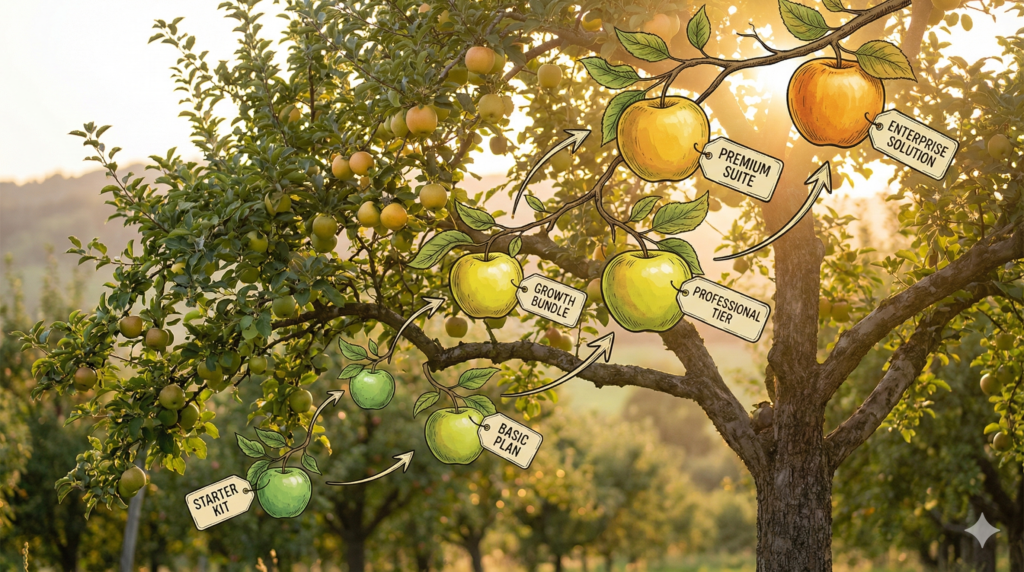
I just created a product about [topic]. What are 3 natural upsells or upgrades someone would want after going through this? For each one, explain why it’s the logical next step and what additional value it provides.
My main product teaches [skill/outcome]. What complementary product could I create that solves a related problem this audience faces? Suggest 3 options and explain how each one fits into the customer journey.
Someone just finished Section [X] of my product. They got [specific result]. What upgrade could I offer that makes this result faster, easier, or more comprehensive? Describe the upgrade in 2-3 sentences.
I want to create a ‘lite’ version of my product as a lead magnet. What’s the core transformation I should include that gives value but leaves them wanting more? What should I leave out so the full product still feels necessary?
My product includes [tool/template/resource]. What expanded version of this could I sell as an upgrade? Describe what the upgrade would include and why someone would pay extra for it.
After someone completes my product, what’s the next problem they’ll face? Suggest a follow-up product that solves that problem and positions itself as the natural continuation.
I have a main product about [topic]. What ‘done-for-you’ or ‘done-with-you’ service could I offer as a premium upsell for people who want more hands-on help?
Someone loves [specific section] of my product. How could I turn that section into a standalone mini-product or upgrade? What would I need to add to make it worth buying separately?
I want to bundle my product with something else. What type of complementary offer would make sense? Suggest 3 bundle ideas and explain why each one increases the perceived value.
My audience struggles with [related problem] in addition to [main problem my product solves]. Create a product concept for a cross-sell that addresses the related problem and positions itself as the perfect companion to my main product.

Delivery Optimization and User Experience
Building the product is one thing. Getting people to actually finish it? That’s a different challenge entirely. Completion rates tank when delivery feels overwhelming, confusing, or like too much work.
These prompts help you structure delivery, pacing, and user experience so people don’t just buy—they complete. They suggest formats, drip schedules, progress markers, and engagement tactics that keep momentum alive.
Use these when you’re planning how to get your finished product into people’s hands without them abandoning it halfway through.
I have a product with [X] sections. Should I deliver it all at once, or drip it over time? If drip, suggest a schedule that balances momentum with completion rates. Explain your reasoning.
My product includes [list main components]. What’s the best format for each piece? Should some be video, some be PDF, some be worksheets? Suggest the optimal format based on the content type and how people will use it.
How should I structure the first 24 hours after someone buys my product? What should they receive, when should they receive it, and what action should I guide them to take first?
I want to include progress markers so people feel like they’re making headway. Where should I place milestones in this product outline: [paste outline]? What should each milestone celebrate?
My product is [X] pages long. Is that too much? Should I split it into multiple modules, create a condensed version, or leave it as-is? Give me a recommendation based on completion rates.
I’m delivering this product as a PDF. What additional elements could I include (worksheets, checklists, templates) to make it more interactive and increase engagement?
Someone just bought my product. What’s the best way to onboard them? Suggest a welcome sequence that gets them oriented, engaged, and taking action within the first week.
I want people to implement as they learn, not just consume the content. How should I structure the product to force action at each stage? Suggest 3 tactics that increase implementation.
My product has a lot of steps. How do I keep people from getting overwhelmed? Suggest a pacing strategy and explain how to break it into manageable chunks.
I’m seeing low completion rates. What could be causing this? Based on this product outline [paste outline], where are people most likely dropping off, and how do I fix it?
Putting It All Together
You’ve got a hundred prompts now. They’re not random. They’re not disconnected. They’re built to work in sequence, stacking on top of each other, creating one long conversation that takes you from “I have this idea” to “here’s the product, the sales page, and the email sequence.”
Most people will grab one or two prompts and think that’s enough. It’s not. The power here isn’t in cherry-picking. It’s in running the full relay. Start with validation. Build the outline. Create the product. Write the sales copy. Map the follow-up. Then refine, tighten, and optimize.

Every time you do this, you’ll get faster. You’ll recognize which prompts fit your style. You’ll know when AI is giving you bland output and exactly how to sharpen it. The process becomes muscle memory.
And here’s what shifts: you stop starting from scratch every single time. You stop staring at blank pages wondering where to begin. You stop hoping your sales copy matches the product because everything connects—you built it all in one thread, with AI carrying context from start to finish.
This is how you turn ideas into income without burning weeks on each asset. This is how you create products that sound like you, solve real problems, and set up the next sale without forcing it. This is the relay method working exactly the way it should.
Products / Tools / Resources
If you’re running this relay method and want to streamline the process even further, here are some tools worth considering:
**Claude or ChatGPT Plus** – You’ll need a solid conversational AI that can maintain context across long threads. Both work, but Claude tends to hold context better over extended conversations, which matters when you’re running a full relay.
**Notion or Google Docs** – Keep your relay outputs organized. Create a workspace where each section (validation, outline, product draft, sales copy, email sequence) lives in one place. You’ll reference earlier outputs constantly, so having everything searchable helps.
**Hemingway Editor** – After AI generates content, run key sections through Hemingway to check readability. It catches overly complex sentences and passive voice that make content feel stiff.
**Grammarly** – Not for grammar policing, but for catching repetitive phrasing AI tends to default to. The tone detector also flags when something sounds too formal or robotic.
**Loom or Descript** – If you’re turning written content into video or audio, these make the transition smooth. Loom for quick screen recordings, Descript for editing and transcription.
**ConvertKit or Beehiiv** – When you’re ready to automate email sequences, both platforms handle drip campaigns and segmentation without overcomplicating things.
**Gumroad or Stan Store** – For delivering digital products with minimal setup. Both support instant delivery, upsells, and simple checkout flows.
**Airtable** – If you’re managing multiple products or relays simultaneously, Airtable keeps everything visible in one dashboard. You can track which stage each product is in and what still needs work.
**Canva or Figma** – Sales pages need visuals. Canva works if you want templates. Figma gives you more control if you’re building custom landing pages.
**Zapier** – Connect your tools so when someone buys, they’re automatically added to the email sequence, given access to the product, and logged in your tracker. Cuts out manual busywork.