
Emerging Trends for 2026: Agentic AI & Universal Interfaces
The Dawn of the Agentic Era
As organizations worldwide accelerate their digital transformation initiatives, 2026 marks a pivotal inflection point in artificial intelligence evolution. Gartner forecasts that 15% of daily work decisions will be executed autonomously through agentic AI by 2028, compared to essentially zero in 2024, while one-third of enterprise software applications will incorporate agentic AI capabilities by the same timeframe. This represents more than incremental progress—it signals a fundamental reimagining of how humans interact with technology and how businesses operate at scale.
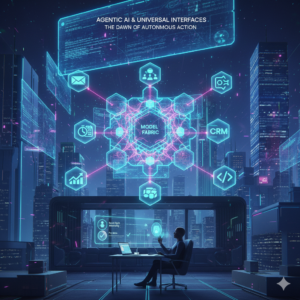
Two interconnected trends are converging to reshape the enterprise technology landscape: agentic AI systems that can autonomously manage complex workflows, and universal interfaces that consolidate disparate tools into unified, natural language experiences. Together, these developments promise to eliminate the friction that has long plagued digital work, creating seamless experiences where AI handles execution while humans focus on strategy and creativity.
This article explores these transformative trends, examining their practical implications, implementation challenges, and the strategies forward-thinking organizations are deploying to capture competitive advantage in the agentic age.
Understanding Agentic AI: Beyond Simple Automation
What Makes AI “Agentic”?
Agentic AI represents a shift from systems that merely complete individual tasks to those that manage entire multi-step workflows with contextual understanding and goal-driven decision-making. Unlike traditional automation or even generative AI assistants, agentic systems can maintain context across complex processes, monitor progress autonomously, and determine subsequent actions without constant human direction.
The distinction is fundamental. Where conventional chatbots answer questions and basic automation executes predefined scripts, agentic AI interprets objectives, breaks them into executable steps, orchestrates resources across systems, and adapts to changing circumstances—all while operating within defined governance boundaries.
Major technology companies including Salesforce and Google Cloud are now developing cross-platform AI agents using protocols like Agent2Agent (A2A), establishing interoperable foundations for truly agentic enterprises. This collaborative infrastructure enables agents from different vendors to communicate seamlessly, dramatically expanding the scope of what autonomous systems can accomplish.
The Multi-Agent Architecture Revolution
The most practical approach emerging for 2026 involves multi-agent systems where specialized AI agents handle defined responsibilities while an orchestration layer coordinates workflows between them. Rather than deploying monolithic, general-purpose agents that attempt everything, organizations are finding greater success with domain-specific agents that excel at particular functions.
Consider an enterprise procurement workflow: one agent validates budget availability, another negotiates supplier terms, a third manages compliance reviews, and a fourth coordinates fulfillment logistics. Each operates within a narrow scope with clear accountability, while orchestration ensures the overall objective is met. This architecture mirrors how effective human teams already function, making it intuitive to manage and easier to troubleshoot when issues arise.
These multi-agent ecosystems ensure context-sharing, conflict resolution, comprehensive audit trails, and robust governance mechanisms, enabling AI teams to function with the reliability and transparency that enterprise operations demand.
Bounded Autonomy: The Pragmatic Path Forward
Most organizations deploying agentic AI in 2026 are implementing bounded autonomy—systems that operate independently within clearly defined parameters, incorporating checkpoints, escalation pathways, and human oversight to balance operational efficiency with risk management.
This approach recognizes that complete autonomy remains impractical for most business contexts. Instead, successful implementations define decision boundaries, establish approval thresholds, implement real-time monitoring, and create clear escalation triggers. When agents encounter situations outside their training or authority, they pause and request human judgment rather than guessing.
At Toyota, teams leverage agentic tools to enhance visibility into vehicle arrival times at dealerships and will soon deploy agents to resolve supply chain issues autonomously—workflows that previously required navigating 50 to 100 mainframe screens with extensive manual intervention. The key enabler isn’t removing humans entirely but rather eliminating repetitive coordination work and allowing professionals to focus on exception handling and strategic decisions.
The Business Case: Real-World Applications and ROI
Workflow-Level Impact Drives Value Creation
The genuine value proposition of agentic AI emerges not from automating isolated tasks but from managing end-to-end workflows across systems, significantly reducing manual coordination and recovery efforts. Organizations capturing meaningful returns are those deploying agents to own entire processes rather than simply accelerating individual steps.
In customer service contexts, this means agents that don’t just answer questions but autonomously access customer history, identify root causes, process refunds or replacements, update inventory systems, trigger shipment workflows, and send confirmations—all without human intervention for straightforward scenarios. The enterprise model is shifting from seeking chatbots to building AI agents that execute complete workflows.
Organizations like Telus report that more than 57,000 employees regularly use AI systems, saving approximately 40 minutes per AI interaction, while Suzano developed an AI agent that translates natural language questions into SQL code, achieving a 95% reduction in query time across 50,000 employees. These aren’t marginal improvements—they represent fundamental changes in operational capacity.
Scaling Challenges and Success Factors
Despite widespread experimentation, enterprise-scale deployment remains challenging. While 39% of organizations surveyed by McKinsey are experimenting with agents, only 23% have begun scaling AI agents within one business function, and even fewer report material enterprise-level returns.
The gap between pilot success and production scale reflects several persistent obstacles. Multi-agent systems present significant technical complexity in construction and operation, while vendors remain hesitant to make systems interoperable as they determine monetization strategies around the data agents generate and consume. Additionally, organizations struggle with governance frameworks, integration with legacy systems, change management, and building AI-literate workforces.
According to research examining the evolution toward agentic organizations, 89% of companies still operate with industrial-age structures, only 9% have adopted agile or platform operating models from the digital age, and merely 1% function as decentralized networks. This structural inertia means that deploying advanced AI requires simultaneous organizational transformation.
A Deloitte study reveals that while 30% of surveyed organizations are exploring agentic options and 38% are piloting solutions, only 14% have production-ready deployments and just 11% are actively using these systems at scale. Furthermore, 42% report still developing strategic roadmaps, with 35% lacking formal strategies entirely.
Successful implementations share common patterns: they start with specific, well-defined workflows rather than ambitious enterprise-wide rollouts; they establish robust governance frameworks before scaling; they invest heavily in integration infrastructure; and they prioritize change management and workforce development alongside technology deployment.
Universal Interfaces: Simplifying the Complexity
The Problem with Dashboard Proliferation
For decades, IT professionals across DevOps, ITOps, and SRE roles have navigated sprawling arrays of dashboards, user interfaces, and tools—each with its own complex interface paradigms, steep learning curves, and operational inefficiencies. The average knowledge worker toggles between numerous applications daily, context-switching constantly and manually aggregating information across siloed systems.
This fragmentation imposes substantial cognitive overhead, creates opportunities for errors, requires continuous training as interfaces evolve, and traps insights within individual applications where they provide limited strategic value. Each tool demands users invest significant time mastering its interface, while constant UI changes across multiple tools necessitate ongoing retraining.
The proliferation reflects how software evolved—applications were built independently, optimized for specific functions, without consideration for how users would coordinate across them. As organizations adopt increasingly sophisticated technology stacks, the coordination burden only intensifies.
The Universal Interface Vision
The future of IT operations will not be defined by clicking through endless dashboards but instead shaped by AI agents that can accept high-level requests, autonomously decompose them into executable steps, invoke APIs across various tools, and synthesize results into actionable insights.
This paradigm shift replaces disparate application interfaces with a single natural language layer. Instead of learning where specific functions live in multiple applications, users simply articulate their intent: “Identify all servers with utilization below 20% and prepare a cost optimization proposal,” or “Show me why API latency increased yesterday and what remediation options we have.”
Rather than navigating through menus or typing structured queries, users will interact with software by simply asking or instructing in human language, with AI-native interfaces built around AI’s capabilities to understand and execute intent. The interface becomes conversational, proactive, and contextually aware—adapting to user needs dynamically rather than forcing users to adapt to static menu structures.
Design studios are envisioning “General Purpose Interfaces” where one master AI-powered interface could organize everything users do on their devices, replacing the fragmented app-centric model with a unified intelligent layer. While still largely speculative, these concepts point toward a future where the interface itself becomes invisible, with AI handling the complexity of coordinating across tools while presenting unified, coherent experiences.
Benefits and Transformation Potential
Universal interfaces deliver several compelling advantages. They eliminate context switching by providing single access points for all functions; they reduce training requirements since natural language is intuitive; they enable adaptive learning as systems improve based on usage patterns; and they surface insights more effectively by synthesizing information across previously siloed sources.
By 2026, 80% of organizations plan to integrate AI agents, primarily for tasks driving automation and productivity gains, with IT professionals increasingly relying on agents to handle wide-ranging tasks through simple, intuitive chat interfaces.
The transformation extends beyond mere convenience. Universal interfaces fundamentally change how work gets done by shifting human effort from execution to strategic direction, reducing error rates through consistent AI-mediated processes, accelerating decision-making by eliminating information retrieval friction, and democratizing access to sophisticated capabilities that previously required specialized expertise.
Convergence: Agentic AI Meets Universal Interfaces
Multimodal and Conversational AI Trends
IDC forecasts that by 2026, 40% of AI models will blend different data modalities, surpassing constraints of single-modality systems and improving their effectiveness and self-learning capabilities. Users increasingly expect to interact with AI systems through text, voice, images, video, and gestures—choosing the most natural medium for each context.
Text is losing its monopoly as consumers demand agents they can talk to, gesture toward, and interact with naturally, with voice interaction expected to outpace text in growth rate. This evolution recognizes that different tasks suit different interaction modes: complex analysis might warrant visual dashboards, routine requests work well with voice commands, and nuanced problem-solving benefits from conversational back-and-forth.
AI systems are adopting multimodal interfaces, combining text, voice, images, and videos to create more immersive interactions, with 30% of AI models expected to utilize multiple data modalities by 2026, enhancing the richness of user interactions.
Modern conversational AI has evolved dramatically. Companies are adopting technologies like OpenAI’s Realtime API to deliver conversations that feel immediate, dynamic, and context-aware, with automated interactions in 2026 feeling remarkably natural. These systems don’t merely process language—they understand intent, maintain context across conversations, detect emotional cues, and adapt their responses to user needs and preferences.
Emotional Intelligence and Personalization
Conversational AI is integrating emotional intelligence to better understand and respond to human emotions, with the emotional AI market projected to grow from $19.5 billion in 2020 to $37.1 billion by 2026. Startups and major technology companies are developing systems that detect frustration, sarcasm, satisfaction, and other emotional states in real-time, enabling more empathetic and effective interactions.
This emotional awareness allows AI agents to adjust tone and approach dynamically, escalate to humans when tension rises, provide reassurance during uncertainty, and celebrate successes alongside users. The result is experiences that feel genuinely supportive rather than mechanically transactional.
Personalization extends beyond emotional intelligence to comprehensive context awareness. Advanced systems maintain memory of past interactions, understand individual user preferences and work styles, anticipate needs based on patterns, and proactively offer assistance before problems escalate. Systems now execute workflows automatically rather than merely answering questions, with enterprises increasingly viewing conversational AI as an internal operating interface rather than a customer service tool.
Generative UI and Dynamic Experiences
Generative UI represents a capability where AI models generate not only content but entire user experiences, dynamically creating immersive visual experiences and interactive interfaces—including web pages, games, tools, and applications—automatically designed and fully customized in response to any question, instruction, or prompt.
This innovation moves beyond static, predefined interfaces where AI renders content within fixed templates. Instead, the interface itself becomes generated content—adapting its structure, layout, interactivity, and visual design to match the specific request. A user asking about financial trends might receive an interactive dashboard with customized visualizations, while someone planning an event gets a drag-and-drop timeline interface, and a student exploring science concepts sees an interactive simulation.
When ignoring generation speed, interfaces from generative UI implementations are strongly preferred by human evaluators compared to standard LLM outputs, representing a first step toward fully AI-generated user experiences where users automatically get dynamic interfaces tailored to their needs rather than selecting from existing application catalogs.
Google has introduced this concept through Dynamic View in the Gemini app and AI Mode in Google Search, where Gemini generates bespoke interfaces instantly based on user prompts. These aren’t static results pages—they’re fully interactive, contextually relevant tools built on-the-fly.
Implementation Strategies and Best Practices
Starting with Governance and Strategy
Governance frameworks, auditability, explainability, and ethics are becoming fundamental to building enterprise trust, with trust itself serving as the foundation for scaling AI-powered agent systems across businesses. Organizations that establish robust governance before aggressive scaling consistently achieve better outcomes than those attempting to retrofit controls after deployment.
Effective governance encompasses several dimensions. Technical governance includes model validation, performance monitoring, bias detection, and data quality management. Operational governance covers decision authority boundaries, approval workflows, escalation protocols, and human oversight mechanisms. Compliance governance ensures regulatory adherence, audit trail maintenance, data protection, and ethical AI principles.
Being “AI ready” means having appropriate structures in place before implementing AI technology, including preparing infrastructure and governance frameworks. This preparation work feels less exciting than deploying cutting-edge models, but it determines whether implementations deliver sustainable value or create technical debt and compliance risks.
Organizations should document AI principles and policies, establish cross-functional governance committees, create review processes for agent deployment, implement monitoring dashboards, and build mechanisms for continuous evaluation and improvement. These foundations enable confident scaling.
Scaling from Pilots to Production
Scaling begins with identifying the right specific tasks rather than pursuing overly ambitious projects without clear goals. Successful organizations typically follow a crawl-walk-run progression: they identify high-value, well-defined workflows where automation can deliver clear ROI; they pilot with limited scope and intensive monitoring; they refine based on real-world performance; and they gradually expand to adjacent use cases while maintaining governance standards.
The most effective pilots share common characteristics—they address genuine pain points where manual work creates bottlenecks, they have measurable success criteria defined upfront, they involve end-users throughout design and testing, and they’re sized appropriately to deliver results quickly without overwhelming teams.
AI-fueled coding and autonomous agents are dramatically accelerating software development cycles, making it feasible to build on-demand applications that can independently adapt to new requirements faster than traditional development cycles. This acceleration means organizations can experiment rapidly, learning what works through iteration rather than attempting to perfect designs upfront.
Integration infrastructure deserves particular attention. AI agents now operate across CRM platforms, support tools, HR systems, DevOps software, and billing platforms, with single conversations capable of updating records, creating tickets, triggering workflows, and notifying teams across multiple systems. Building robust integration layers—with proper error handling, retry logic, security controls, and observability—determines whether agents function reliably at scale.
Workforce Development and Change Management
During 2026, organizations will move from simply buying AI to building AI-ready workforces, transitioning away from one-off training toward developing adaptable, continuous learning plans with hands-on practice using real-world scenarios. Technology deployment alone doesn’t create value—people must understand how to work effectively alongside AI, when to trust agent recommendations, and when to intervene.
Change management requires addressing several human factors. Many employees fear displacement rather than augmentation, necessitating clear communication about how AI changes roles rather than eliminating them. Others struggle with ambiguity about accountability when agents make decisions, requiring explicit frameworks for human-AI collaboration. Some simply need time and support to develop new skills and comfort with AI-mediated work.
Effective programs include role-specific training tailored to how different functions will interact with agents; hands-on experimentation in safe environments where mistakes don’t have business consequences; ongoing support through communities of practice; and visible leadership commitment to the transformation. Forty-two percent of organizations are expected to hire for AI-focused CX roles, such as conversational AI designers and automation analysts, by 2026.
Challenges and Considerations
Technical Complexity and Interoperability
Multi-agent systems are technically challenging to build and operate, with vendors hesitant to make such systems interoperable as they determine monetization strategies around the data agents generate and consume. Each vendor maintains proprietary approaches to agent communication, data schemas, and security models, creating integration friction.
The challenge intensifies in heterogeneous technology environments where organizations use best-of-breed solutions from multiple vendors. Without standardized protocols, each integration becomes custom work—expensive to build initially and costly to maintain as systems evolve. APIs for one vendor’s customer service platform don’t work with those of another vendor’s ecommerce software, with vendors working at cross-purposes as they seek to compete and protect their data advantages.
Industry-wide standards for agent-to-agent communication, like the A2A protocol, offer promise but remain early-stage. Organizations must balance waiting for standardization against moving forward with current solutions, often choosing pragmatic hybrid approaches.
Security, Privacy, and Compliance
Agentic systems with broad access to enterprise data and authorization to take actions create significant security considerations. Agents require authentication and authorization frameworks that prevent unauthorized access; they need encryption for data in transit and at rest; they must maintain comprehensive audit trails for compliance; and they require safeguards against prompt injection attacks and other AI-specific vulnerabilities.
Privacy concerns intensify as agents synthesize information across systems, potentially correlating data in ways that expose sensitive information unintentionally. Organizations must implement data minimization principles, establish clear retention policies, ensure agents respect access controls, and provide transparency about what data agents access and why.
Regulatory compliance adds another layer of complexity. The EU AI Act sets risk-based rules for AI systems, with progressive timelines from 2025 to 2026 and beyond, including transparency and documentation obligations that affect even organizations outside the EU when serving large customers. Compliance requires understanding regulatory requirements across jurisdictions, implementing required transparency mechanisms, maintaining documentation for audits, and establishing processes for responding to regulatory inquiries.
Managing User Expectations and Trust
Forrester predicts that in 2026, three in ten firms will actually damage their growth prospects due to poorly deployed AI self-service, with rushed automation creating “loops of frustration” where customers are trapped in circular bot conversations without off-ramps to humans.
The differentiator isn’t having AI but knowing when to hide it, when to make it visible, and when to seamlessly transition to human assistance. Users quickly become frustrated with agents that over-promise and under-deliver, that fail to understand context, or that provide no path to human help when needed.
Nearly one in five consumers who used AI for customer service saw absolutely no benefit from the experience, with failure rates nearly four times higher than for other AI tasks, while consumer trust in organizations to use AI responsibly sits at only 29%. This trust deficit means organizations must work harder to demonstrate reliability, transparency, and respect for user preferences.
Building trust requires setting accurate expectations about agent capabilities; providing transparent explanations of how agents reach decisions; offering easy escalation to human assistance; demonstrating consistent performance over time; and respecting user choices about when and how they interact with AI.
Looking Ahead: The Agentic Enterprise of 2026 and Beyond
The Democratization of AI
The rise of agentic automation will mark the true democratization of AI, where every company can wield intelligence at scale, though only those with appropriate governance foundations will transform availability into competitive advantage.
As platforms mature and costs decline, AI capabilities that once required sophisticated data science teams are becoming accessible through low-code and no-code tools. By 2025, nearly 70% of new applications are expected to be built using low-code tools, meaning the bottleneck is no longer engineering resources but imagination. This democratization empowers operators, marketers, and team leads to deploy AI solutions directly, accelerating adoption and experimentation.
Small and medium businesses gain access to capabilities previously available only to large enterprises. Startups can compete with incumbents by leveraging AI to punch above their weight. Organizations in traditionally less-digitized industries can leapfrog modernization phases. The competitive landscape fundamentally shifts as AI capability becomes less about budget and more about strategic vision and execution discipline.
From Efficiency to Innovation
While early agentic AI deployments focus primarily on efficiency—automating repetitive tasks, reducing costs, accelerating processes—the more profound impact will emerge as organizations leverage freed capacity for innovation and value creation.
When professionals spend less time on execution and coordination, they can focus on strategic thinking, creative problem-solving, and building relationships. When agents handle routine customer inquiries, human agents can tackle complex situations requiring empathy and judgment. When developers offload boilerplate coding to AI, they can concentrate on architectural decisions and user experience.
Meaningful enterprise-wide impact from AI use remains rare, though survey results suggest thinking big can pay off, with AI high performers—representing about 6% of respondents who attribute EBIT impact of 5 percent or more to AI—reporting that they push for transformative innovation via AI, redesign workflows, scale faster, implement transformation best practices, and invest more.
The most successful organizations view agentic AI not as cost reduction technology but as capability expansion technology—enabling them to serve more customers, enter new markets, launch innovative products, or operate in previously impossible ways.
Preparing for the Next Wave
The future belongs to those who choose to learn, adapt, and grow, with 2026 seeing growing harmony between humans and their AI assistants. Organizations preparing for this future are investing across multiple dimensions simultaneously.
They’re building technical infrastructure that supports AI integration, including modern data platforms, API-first architectures, and cloud-native environments. They’re developing organizational capabilities through workforce development, process redesign, and cultural evolution toward experimentation and continuous learning. They’re establishing governance frameworks that enable confident scaling while managing risks. And they’re cultivating partnerships with technology vendors, implementation specialists, and industry peers to accelerate learning.
The pace of change shows no signs of slowing. Models continue improving rapidly, making previously impossible applications suddenly feasible. New interaction paradigms emerge regularly, reshaping user expectations. Regulatory frameworks evolve, creating both constraints and opportunities. Successful organizations embrace this dynamism, building adaptive capability rather than rigid implementations.
Conclusion: Embracing the Transformation
Agentic AI and universal interfaces represent more than incremental improvements to existing work methods—they constitute a fundamental reimagining of human-computer interaction and organizational operations. Agentic AI is the biggest operational shift since cloud computing, with early adopters in 2026 not just optimizing but actually disrupting entire industries.
The transformation creates winners and losers. Organizations that move decisively while building proper foundations will capture sustainable competitive advantages through operational excellence, enhanced customer experiences, and freed capacity for innovation. Those that hesitate risk falling behind as competitors leverage AI to operate at unprecedented speed and scale. Those that rush forward without governance and strategy will likely face costly failures that erode confidence and waste resources.
The path forward requires balancing ambition with pragmatism—thinking boldly about possibilities while executing disciplined implementations, embracing technological capability while maintaining human oversight and values, and moving quickly while building sustainable foundations.
As we progress through 2026 and beyond, the question isn’t whether agentic AI and universal interfaces will reshape work—that transformation is already underway. The question is how organizations will navigate this transition, what role they’ll play in defining the agentic future, and how they’ll capture the extraordinary value these technologies make possible.
The agentic era is here. Success belongs to those who embrace it thoughtfully, strategically, and relentlessly.