AI to Human-Pulse Audit
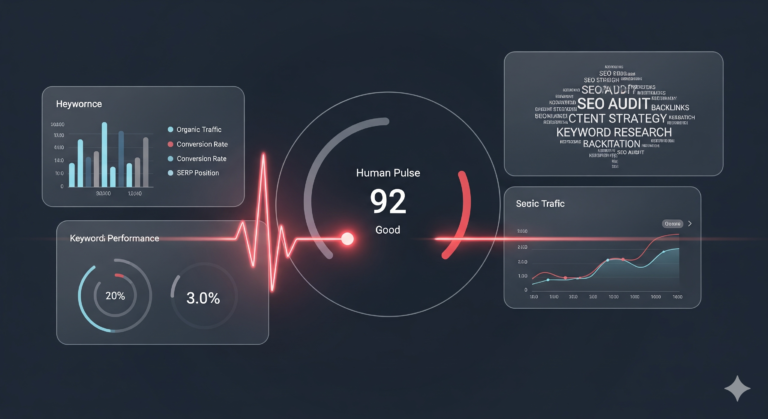
The Human-Pulse Audit is a specialized, privacy-first web utility designed to bridge the gap between AI-generated content and high-quality human writing. Unlike binary “AI detectors,” this tool performs a nuanced linguistic audit to help creators satisfy Google’s E-E-A-T (Experience, Expertise, Authoritativeness, and Trustworthiness) requirements.
Key Features
Three-Pillar Analysis:
Experience Markers: Scans for first-person narratives and personal anecdotes that signal authentic human involvement.
Sentence Burstiness: Analyzes rhythmic variance in sentence structure to identify the monotonous patterns typical of large language models.
Information Gain: Measures the density of specific data, entities, and unique insights compared to generic “common knowledge” summaries.
Direct URL Fetcher: Integrated scraping logic (via a CORS proxy) allows users to pull content directly from any live blog post or article for instant auditing.
Logic Visualization: A real-time highlighter that maps out specific text segments, color-coding them by experience signals, unique data, or repetitive AI patterns.
Content Diagnosis Lab: A sidebar module that flags specific sentences for “Robotic Transitions” or “Rhythmic Monotony,” offering instant “Before vs. After” suggestions for improvement.
Interactive Improvement Playbook: A dynamic helper that provides actionable strategies to boost scores, automatically highlighting the advice most relevant to the current audit results.
Who It Is For
The Human-Pulse Audit tool is specifically engineered for professionals navigating the “post-AI” content landscape:
SEO Specialists & Content Strategists: For those needing to ensure their content survives Google’s “Helpful Content” updates and satisfies E-E-A-T requirements.
AEO (Answer Engine Optimization) Marketers: For creators aiming to win citations in AI Overviews (SGE) and Answer Engines like Perplexity by providing high “Information Gain.”
Digital Publishers & Bloggers: To maintain brand authority and a unique editorial voice that differentiates them from generic, automated niche sites.
AI Content Editors: For professionals who use LLMs for drafting but need a rigorous framework to “humanize” the output before publication.
Brand Managers: To ensure that outward-facing copy maintains a personal, relatable “human pulse” that builds trust with consumers.
How to Use It (Step-by-Step)
1. Import Your Content
You have two ways to start your audit:
Manual Paste: Copy your draft from your editor and paste it into the Content to Analyze window.
URL Fetch: Paste a live link into the top bar. The tool will bypass CORS restrictions, strip away navigation/ads, and pull the core article text automatically.
2. Run the Audit
Click “Run Audit.” The JavaScript engine will immediately process your text locally. It calculates the standard deviation of sentence lengths (Burstiness), scans for personal narrative markers (Experience), and checks for data-density signals (Information Gain).
3. Analyze the Visualization
Look at the Logic Visualization pane.
Green highlights show where you’ve successfully injected personal experience.
Blue highlights show your unique data points.
Red highlights show repetitive AI “fluff” patterns that need to be cut.
4. Consult the Diagnosis Lab
Check the sidebar flags. If the tool detects “Rhythmic Monotony,” it means your sentences are too similar in length. Use the “Fix” suggestions to break up the flow and create a more natural, human rhythm.
5. Apply Playbook Strategies
If your Pulse Score is low, open the Improvement Playbook. It provides specific prompts and writing techniques (like adding “contrarian takes” or “lesson-learned” markers) to boost your score and your SEO potential.
Frequently Asked Questions (FAQs)
Q: Is this a binary AI detector?
No. We believe binary “AI vs Human” detectors are often inaccurate and punitive. Instead, this is a Quality Audit. It measures the characteristics of high-quality human writing. Even if you wrote a text entirely by hand, if it is dry, repetitive, and lacks personal insight, it will receive a low score because that content is unlikely to rank well in modern search engines.
Q: Why is “Burstiness” important for SEO?
Search Engine algorithms are increasingly sophisticated at identifying “predictable” text. AI tends to produce sentences of very similar lengths and structures. “Burstiness” refers to the variance in sentence rhythm. Content with high burstiness feels more natural to readers and signals to search engines that the content wasn’t generated by a standard, monotonous algorithm.
Q: How does this help with AEO (Answer Engine Optimization)?
Answer Engines (like Google AI Overviews or Perplexity) look for Information Gain. If your content just repeats what every other site says, the AI has no reason to cite you. Our tool tracks “Unique Data/Entities.” By increasing these markers, you provide “new” information to the index, making your site a primary source for AI-generated answers.
Q: Does this tool store my data?
No. The Human-Pulse Audit runs entirely in your browser’s memory (Client-Side). Your text is never sent to a server or used to train any AI models. As soon as you refresh the page or clear the text, the data is gone.
Q: What is a “Good” Pulse Score?
85-100%: Excellent. Highly resistant to AI-pattern filters; strong E-E-A-T signals.
70-85%: Solid. Good human signal, but could benefit from more specific data or rhythmic variety.
Below 50%: High Risk. The content likely feels “hollow” or generic. It may struggle to rank against competitors who offer more personal insight or unique data.