
AI Prompt Engineering & GEO/AEO Enhancement:
Shaping the Future of Smart Content
Executive Summary
This article explores the transformative intersection of artificial intelligence, prompt engineering, and modern optimization strategies that are revolutionizing digital content creation and discovery. As traditional search engine optimization (SEO) evolves, two powerful paradigms—Geographical Engine Optimization (GEO) and Answer Engine Optimization (AEO)—are emerging as essential tools for content creators and marketers seeking to maximize their global reach and engagement.
The article examines how sophisticated AI prompt architecture enables businesses to create contextually relevant, culturally adapted content that resonates across diverse audiences worldwide. By integrating prompt engineering with GEO principles (location-based optimization) and AEO strategies (optimizing for AI-powered answer engines), organizations can dramatically enhance both the visibility and effectiveness of their digital presence. This comprehensive approach represents a fundamental shift from outdated keyword strategies to intelligent, adaptive content creation that anticipates and meets the evolving needs of modern search behaviors and AI-driven discovery platforms.
Introduction: A New Era of Digital Discovery
Imagine a world where artificial intelligence understands not only your intent but also delivers results uniquely crafted for both global audiences and the ever-evolving demands of online algorithms. Picture an AI system that seamlessly tailors content for diverse languages, cultures, and user preferences, while navigating the complex landscape of digital platforms. This isn’t some distant future—AI prompt engineering and the integration of GEO (Global Engine Optimization) and AEO (Algorithm Engine Optimization) are rapidly transforming how content is produced, discovered, and interacted with every day.
Instead of creating one-size-fits-all material, creators and marketers now have the tools to ensure their messages are contextually and algorithmically enhanced, breaking through barriers and capturing attention anywhere in the world. Just consider the possibilities: What if your content could automatically modify itself to suit shifting trends, search behaviors, and user intent on a global scale? How much greater could your reach and impact become if your content was always optimized for discovery and engagement, wherever your audience is? This is the new frontier in digital communication—where adaptability isn’t just an advantage, but a necessity.
Understanding AI Prompt Architecture
Artificial Intelligence (AI) has fundamentally transformed the way we interact with information, especially through conversational platforms and search engines. At the heart of this transformation is AI prompt architecture—a systematic approach to designing the inputs or prompts that guide AI models in generating precise, relevant, and contextually accurate responses. Prompt architecture encompasses not only the wording and structure of queries given to AI but also the nuanced understanding of how different input styles can influence the quality and specificity of the answers produced. Mastering this discipline is essential, as it determines the value and usefulness of AI-generated content across a wide range of applications, from customer service bots to content creation tools.
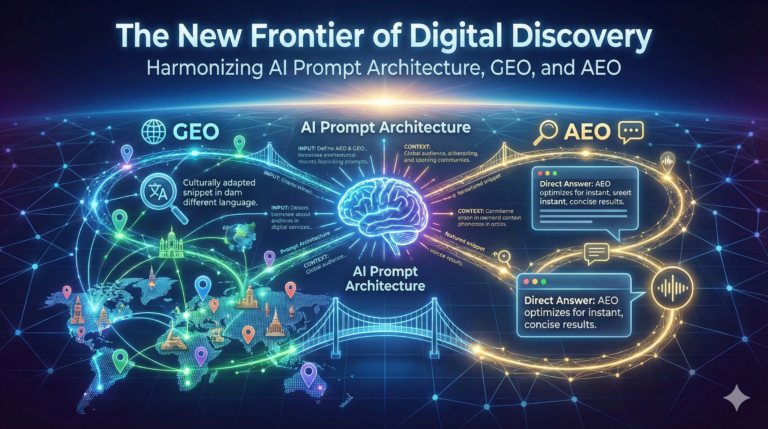
But the landscape is rapidly evolving beyond traditional search engine optimization (SEO). Two emerging paradigms—Geographical Engine Optimization (GEO) and Answer Engine Optimization (AEO)—are redefining how visibility and relevance are achieved online. GEO focuses on optimizing content for location-based queries, ensuring that information is tailored to the specific needs and contexts of users in different regions. Meanwhile, AEO is driven by the rise of AI-powered search engines and answer engines, like Google’s featured snippets and chat-based assistants, which prioritize direct, concise answers over long-form webpages. Unlike SEO, which emphasizes keywords and backlinks, AEO requires crafting content that directly and succinctly answers user questions, while GEO ensures these answers resonate with local audiences.
The increasing adoption of AI-driven search platforms makes these concepts more critical than ever. As people shift from typing simple keywords to asking complex, conversational questions, both the architecture of prompts and the optimization for answer and geographical engines are key to staying visible in search results. Integrating AI prompt architecture with GEO and AEO principles empowers digital content creators to go beyond outdated keyword strategies. This synergy allows brands to produce content that not only aligns with how modern users search for information but also how AI interprets and delivers it, ultimately supercharging digital content strategies for the new era of intelligent online discovery.
The Evolution of Prompt Engineering
Prompt engineering has rapidly evolved alongside advancements in artificial intelligence and natural language processing, shifting from simple keyword commands to intricate frameworks that guide AI toward sophisticated, contextually accurate responses. Early approaches often resulted in vague or off-target outputs, but as practitioners learned to emphasize clarity, specificity, and contextual richness, the effectiveness of prompting improved dramatically. For instance, providing crucial context about the target audience or end goal can transform a generic reply into a nuanced, actionable answer. Conversely, prompts that lack specificity or contain ambiguous instructions typically yield unreliable or confusing results, highlighting the importance of thoughtful design.
Modern prompt architecture now incorporates deliberate frameworks to systematically steer AI. By defining objectives, constraints, and background details, prompt designers can ensure responses are relevant and actionable. This approach is especially valuable when adapting content for diverse audiences—a crucial aspect of GEO (geographic) optimization. Localizing content isn’t just about language translation; it involves cultural adaptation, region-specific references, and sensitivity to varying user preferences. AI tools, empowered by robust prompt architecture, can dynamically generate content that resonates across multiple regions, optimizing engagement and relevance while preserving brand consistency.
Integrating GEO and AEO Strategies
Simultaneously, the landscape of search continues to migrate from traditional SEO to AEO (Answer Engine Optimization). With the rise of conversational search, voice assistants, and AI-generated instant answers, it’s critical to structure prompts that yield succinct, authoritative responses tailored for snippets, FAQs, and voice search results. Techniques such as clearly instructing the AI to summarize, answer concisely, or target featured snippets improve both visibility and usefulness. Measuring AEO effectiveness now involves using metrics that track voice search rankings, answer box placements, and user satisfaction with AI-generated content.
A unified workflow that integrates prompt architecture, GEO adaptation, and AEO strategies empowers businesses and creators to maximize their reach and impact, whether operating locally or globally. Case studies from leading multinational brands illustrate the value of this holistic approach, showing increased user engagement, better conversion rates, and enhanced brand authority. As the field advances, staying attuned to trends—like real-time content adaptation and ongoing learning cycles—will be essential. Moreover, ethical considerations around data privacy and fair representation must remain central to prompt and content design, ensuring AI-driven success is sustainable and responsible in a fast-changing digital landscape.
The Path Forward: Taking Action
The transformative potential of uniting AI prompt architecture with GEO and AEO optimization cannot be overstated. By leveraging the power of advanced prompt engineering alongside sophisticated geo-targeting and answer engine optimization, businesses, creators, and digital strategists are able to dramatically enhance both the reach and effectiveness of their content. This synergy not only amplifies visibility in search results but also ensures that content is contextually relevant and tailored to diverse audiences worldwide. The digital landscape is evolving at a rapid pace, and those who harness this combination position themselves at the forefront of innovation, able to anticipate and meet the changing needs of their target markets.
For professionals and organizations eager to maintain a competitive edge, embracing this integrated approach is no longer optional—it’s essential. With AI-driven tools advancing daily, the ability to adapt and utilize new methodologies such as prompt optimization for both geo-specific and answer-centric platforms is critical. It empowers teams to develop smarter, more agile content strategies, reduce manual workload, and better predict what users are searching for, ultimately leading to increased engagement and higher conversions. As global search engines and AI assistants continue to shape how information is discovered and consumed, only those committed to continuous learning and experimentation will thrive.
Conclusion
Now is the time to take action. Start by experimenting with different prompt structures, analyze how they perform across various geographies, and fine-tune your approach based on real data and AI feedback. Stay adaptable, be willing to pivot your strategies as technology evolves, and keep your focus on the future, where adaptability and insight are the ultimate currencies. Remember, the most successful creators and strategists are those who blend creativity with cutting-edge science. The future belongs to those who master both the art and science of AI in content creation and discovery—those who don’t just follow trends, but set them, charting bold new paths in a world driven by intelligent innovation.
To take your AI content strategy to the next level, explore our comprehensive Prompt Engineer Pro: Elite AI Prompt Architecture with GEO & AEO Optimization resource for advanced techniques and practical implementation guides
FREQUENTLY ASKED QUESTIONS
AI Prompt Engineering with GEO and AEO Optimization
Q1: What is Answer Engine Optimization (AEO)?
A: Answer Engine Optimization (AEO) is the practice of optimizing content for AI-powered search engines and answer engines that prioritize direct, concise answers over traditional webpage rankings. Unlike SEO, which focuses on keywords and backlinks, AEO emphasizes crafting content that directly answers user questions in formats suitable for featured snippets, voice search results, and AI chatbot responses.
Q2: How is AI Prompt Engineering different from regular content creation?
A: AI Prompt Engineering is a systematic approach to designing inputs that guide AI models in generating precise, contextually accurate responses. It involves crafting specific instructions, providing relevant context, and structuring queries to optimize the quality of AI-generated content. Regular content creation relies on human writing, while prompt engineering leverages AI capabilities through strategic instruction design.
Q3: What is GEO (Geographical Engine Optimization) and why does it matter?
A: GEO is the practice of optimizing content for location-based queries and diverse geographic audiences. It goes beyond simple translation to include cultural adaptation, region-specific references, and sensitivity to local user preferences. GEO matters because it ensures your content resonates authentically with audiences in different markets, improving engagement and conversion rates globally.
Q4: Can small businesses benefit from combining prompt engineering with AEO?
A: Absolutely. Small businesses can leverage this combination to compete effectively with larger competitors by creating highly targeted, efficient content that answers specific customer questions. This approach improves local search visibility, automates quality content creation, and enhances discoverability in AI-powered search results—all while reducing manual workload and costs.
Q5: What are the key metrics to track for AEO success?
A: Essential AEO metrics include featured snippet rankings, answer box placements, voice search visibility, zero-click search performance, position in AI-generated responses, click-through rates from answer engines, and user engagement with your content when it appears as a direct answer. These metrics help you understand how effectively your content is being surfaced by AI search platforms.
Q6: How do I integrate GEO and AEO into my existing content strategy?
A: Start by identifying your target geographic markets and key user questions. Structure your content to provide clear, direct answers to common queries while adapting messaging for regional audiences. Use AI prompt engineering to generate culturally appropriate, location-specific content variations. Implement schema markup, optimize for conversational queries, and continuously test performance across different regions and search platforms.
Q7: What’s the biggest mistake to avoid in AI prompt engineering?
A: The most common mistake is lack of specificity and context. Vague or ambiguous prompts lead to generic, unreliable results. Always provide clear objectives, target audience information, desired format, relevant constraints, and sufficient context. Without these elements, even the most advanced AI will produce suboptimal content that fails to meet your strategic goals.
Q8: How is search evolving with AI, and why should I care about AEO now?
A: Search is rapidly shifting from traditional keyword-based queries to conversational, AI-powered interactions through voice assistants, chatbots, and answer engines. Users increasingly expect instant, accurate answers without visiting multiple websites. By adopting AEO now, you position yourself ahead of this transformation, ensuring your content remains visible and relevant as zero-click searches and AI-generated answers become the dominant form of information discovery.