
This website uses cookies to improve your experience. We\'ll assume you\'re ok with this, but you can opt-out if you wish. Read More
In case of sale of your personal information, you may opt out by using the link Do Not Sell My Personal Information
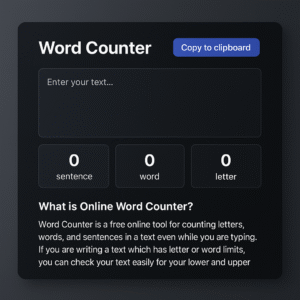
There’s a moment every writer knows—that flicker of uncertainty where you wonder if what you’ve written is too much, too little, or drifting somewhere in the space between. In a world where every platform, professor, and algorithm demands its own specific length, guessing isn’t just inefficient—it’s a quiet form of self-sabotage.
A real-time word counter online removes that doubt with a kind of instant clarity that feels almost like breathing room. No copying. No refreshing. No mental math competing with your ideas. Just words flowing, numbers keeping pace, and a sense of control returning to your hands.
This is more than a utility. It’s a small, steady source of confidence in a digital ecosystem that often feels anything but steady.
Think of it like this: as you type, the tool listens—quietly, carefully—tracking every word, every character, every shift in structure. The numbers update the moment your fingers lift from a key. No lag. No second-guessing. Just immediate truth.
A real-time counter typically displays:
Word count
Character count
Sentences
Paragraphs
Estimated reading time
Readability metrics
Sometimes token estimates for AI-related workflows
It’s a simple idea, but as with most simple ideas, the impact is larger than it looks.
Modern writing lives in a fragmented world. Each platform whispers its own rules—and sometimes shouts them.
Not as a ranking factor by itself, but as a sign of completeness, clarity, and usefulness. A paragraph too thin feels underdeveloped; a page too thick feels bloated. Google evaluates rhythm as much as raw numbers.
On Instagram, TikTok, X, or LinkedIn, characters aren’t negotiable. They’re boundaries you either respect or slam into.
Essays, abstracts, reports—every word counts. Sometimes literally.
Generative tools measure input in tokens, and overstepping limits can break a workflow.
A real-time counter is the quiet guardian of all these rules, letting you navigate them without mentally carrying them.
Under the hood, there’s a lot happening—but it doesn’t feel complicated from the outside.
It tracks the stream of words as you write.
It interprets structure—where a sentence begins, where one ends.
It counts everything at once, in milliseconds.
It uses your browser’s own power, meaning it’s fast, private, and unobtrusive.
Nothing gets saved. Nothing gets sent.
It’s you and the page, uninterrupted, with a tool that behaves like it’s barely there.
Precision becomes a strategy.
You shape meta descriptions to the pixel.
You keep title tags sharp.
You measure the pace of paragraphs so readers (and algorithms) don’t fall off.
You balance depth with scannability.
The counter becomes a subtle but essential part of the craft.
The pressure is different—but just as real.
Word limits aren’t suggestions; they’re boundaries that define the assignment.
A live counter helps you move with confidence instead of fear—no more hovering anxiety about being “over” or “under.”
Captions, bios, ad copy—these are tiny spaces with enormous stakes.
A real-time counter gives you the freedom to express yourself without accidentally crossing the limits that would cause a post to break, truncate, or lose punch.
Each group uses the same tool for different reasons, but the emotional payoff is strangely universal: relief, clarity, and momentum.
You see the tone and clarity of your content shift in real time.
Your pacing becomes more intentional: shorter bursts, longer sweeps, better flow.
Useful for blogs, UX writing, newsletters—anywhere time matters.
A new necessity in a world where human and machine writing increasingly overlap.
The best tools disappear into your process. They don’t interrupt it.
There’s a cognitive shift that happens when you’re no longer switching between writing and checking.
Your attention stays intact.
Your brain stops hopping between creation and calculation.
You slip more easily into a flow state—where ideas move faster and judgment steps aside.
Live numbers also create tiny psychological hooks: little indicators that you’re progressing, improving, shaping something. Micro-motivation. Micro-momentum.
Over time, your instincts sharpen.
You begin to feel what 150 words looks like—what 60 characters feels like.
The tool trains your intuition without ever intending to.
Don’t overthink it. Just begin.
Whether it’s 300 words or 30 characters, goals sharpen your focus.
Let the counter handle the tracking while you stay in the idea.
Use these signals as gentle nudges, not strict rules.
The simplest workflows are often the best ones.
And when the tool becomes part of your everyday writing rhythm, you realize how much mental space you used to waste without it.
Most writers don’t think about this, but the fewer clicks between you and your tools, the more often you use them. Bookmark the counter. Pin it. Add it to your home screen if you’re on mobile.
Writing is hard enough. Finding your tools shouldn’t be.
“Is a real-time counter more accurate than a normal one?”
Yes—because it measures as you type, using parsing logic that matches professional standards.
“Do I really need one if I’m a student?”
If your work is graded on length, absolutely. It saves stress and prevents last-minute rewrites.
“Will it help with SEO?”
More than you might expect. Hit length guidelines without guesswork, tighten structure, and shape content that algorithms understand quickly.
“Does the tool save my writing?”
Most real-time counters process everything in your browser—nothing stored, nothing transmitted.
“Can I use it for social media posts?”
It’s perfect for captions, bios, ad copy, or platforms with strict character limits.
Here are a few resources that pair naturally with a real-time word counter and help elevate your writing workflow:
Real-time word and character counting tools — Ideal for SEO drafts, captions, essays, and ad copy.
Readability analyzers — Helpful for adjusting tone and structure so your writing lands the way you intend.
AI token calculators — Useful if you work with chatbots or generative models that limit prompt length.
Platform-specific character guidelines — Quick references for posting on Instagram, TikTok, LinkedIn, X, YouTube, and more.
Productivity extensions or writing apps — Tools that reduce friction and support deep-focus writing sessions.
This website uses cookies to improve your experience. We\'ll assume you\'re ok with this, but you can opt-out if you wish. Read More
In case of sale of your personal information, you may opt out by using the link Do Not Sell My Personal Information